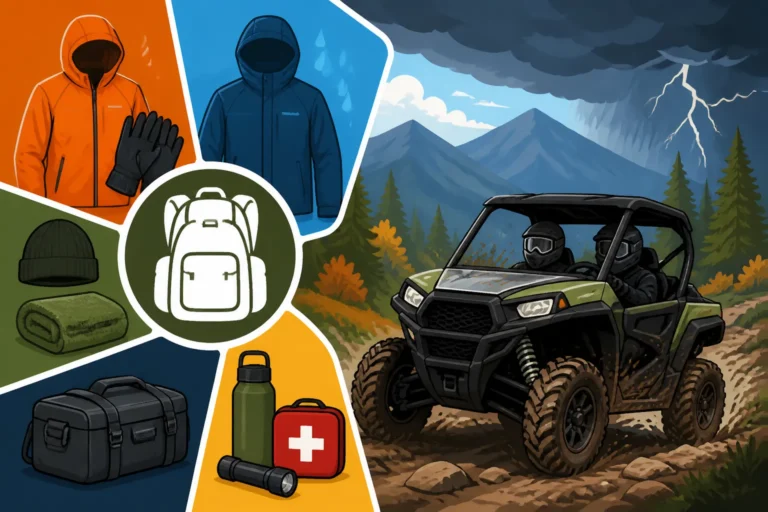
Virginia Trail Riding After Heavy Rain
Heavy rain can turn a familiar Virginia trail into a slippery, rutted route—or leave it closed to protect the trail and the people who maintain it. Before loading your ATV or UTV, check the riding area’s official status, consider how the ground handles water, and have a plan to turn back. This guide helps you make those calls without guessing.
Check trail status before you load up
Look for an official closure, not just a passable-looking route
Rain affects different riding areas in different ways. A trail may look dry near the entrance but still be soft, washed out, or unsafe farther up the mountain. Some operators close trails temporarily after storms; others may keep certain routes open while restricting more vulnerable sections.
Check the riding area’s official website, social media, or trail office before you leave. For Spearhead trails in Southwest Virginia, use information from the organization responsible for the system rather than assuming a route is open because a map still shows it. The same principle applies to Peters Mill Run and Taskers Gap in the George Washington National Forest: check the responsible land manager’s notices and rules before hauling there.
A trail listing or GPS map can help with navigation, but it is not proof that a route is open today. The [Virginia Trail Closures After Rain] guidance is a useful reminder to treat weather-related access as a day-of decision, not something to infer from a previous ride.
Check the full route, not only the trailhead
A long drive to a trailhead makes it tempting to go ahead even when the weather has been rough. It is frustrating to arrive and discover a closure, a washed-out section, or conditions that are beyond what your group can safely handle. A quick call or status check before departure can save that trip.
Ask specific questions: Are the trails open? Are any routes closed or restricted after the rain? Are there known washouts, standing water, or access-road problems? Is the trailhead itself reachable with a truck and trailer? If the answer is uncertain, treat that uncertainty as a reason to choose a different plan rather than a challenge to push through.
Conditions can also vary across one trail system. A lower route may drain quickly while a shaded section, creek crossing, or steep climb remains slick. If staff or local operators describe a particular area as soft or damaged, avoid treating the rest of the system as automatically safe.
Read the ground and choose a realistic ride
Understand what rain changes on Appalachian trails
In Virginia’s mountains, rain can expose the difference between a trail that is merely wet and one that has become difficult or hazardous. Loose rock may become slick, clay can turn greasy, and leaf-covered slopes can hide ruts or erosion. Water crossing a trail may also carry small stones and branches, making familiar sections less predictable.
Coalfield trails near Grundy, Coeburn, or Richlands can include steep grades, rocky stretches, and changing surfaces. On a wet climb, a machine may lose traction and slide sideways rather than move forward. A descent that felt manageable in dry conditions can require more braking distance and a slower pace when the surface is muddy.
Water is not a reliable measure of depth. A shallow-looking puddle may conceal a rut, loose rock, or a soft shoulder. If you cannot see the bottom or judge the trail edges, do not charge through to find out. Stop somewhere stable, check the route on foot only if it is safe to do so, and turn around if you cannot assess the crossing.
Match the route to your machine and the group
After heavy rain, choosing a less demanding route is not being overly cautious; it is adapting to a trail that may have changed since your last visit. A narrow ATV and a wider side-by-side may face different challenges on the same path. A UTV’s width, turning radius, and weight can make a muddy rut or narrow bypass much harder to manage.
Use posted difficulty ratings as a starting point, not a guarantee of how a trail will feel when wet. A route rated for your experience level in dry weather may be a poor choice if it has steep, slick slopes or exposed crossings after rain. The [Virginia Trail Difficulty Ratings] guide can help you think about route selection, but current conditions still matter more than the rating alone.
Before heading out, agree on a conservative turnaround point. For example, a group might decide that if the first steep climb is slick or deeply rutted, everyone turns back together instead of trying to find a way around it. This avoids the common problem of one rider continuing while the rest of the group feels pressured to follow.
| What you notice | What it may mean | A safer choice |
|---|---|---|
| Water flowing across the trail | Runoff may be moving soil or hiding damage | Stop and assess from a safe location; turn back if you cannot see a clear route |
| Deep, fresh ruts | The surface may be soft and vulnerable to further damage | Avoid the rut and do not create a new bypass |
| Slick clay on a slope | Tires may lose grip with little warning | Choose a gentler route or turn around |
| Mud covering trail edges | A firm-looking shoulder may be unstable | Stay on the established route only if it is safe and passable |
| A posted closure or barrier | The route is not open for riding | Do not ride around, under, or through the closure |
| Water over an unknown crossing | Depth and footing may be difficult to judge | Do not enter unless the route and conditions are clearly safe |
Ride responsibly when trails are wet
Stay on the established route
When a muddy section looks unpleasant, it can be tempting to ride around it. That shortcut may damage vegetation, widen the trail, or create a new channel for water. It can also lead riders onto private land or into an unsafe area. If a section is too soft or difficult, turning around is usually better than making a new route.
Wet conditions are hard on both trails and machines. Spinning the tires in place can deepen ruts and throw soil downhill. If traction disappears, ease off rather than continuing to spin. Avoid aggressive throttle and sudden steering, especially on slopes where a small slide can become difficult to control.
Give other riders room, and do not assume they can stop quickly on a slick surface. If you meet another group on a narrow trail, find a stable spot to communicate and pass only when there is enough room. For more on considerate behavior, see [Virginia Trail Etiquette Locals Expect].
Keep a wet-weather ride within your limits
A rainy-day ride can become tiring faster than expected. Mud, water, and repeated slow maneuvers take concentration, while a longer-than-planned return can leave riders cold or worn out. Set a shorter route than you might choose in dry weather, and keep the least experienced rider’s comfort in mind.
Make sure everyone knows the plan and can communicate if the group separates. Cell service can be unreliable in mountain terrain, so do not depend on a phone signal as your only safety measure. Download or save the route information before leaving service. Tools such as onX Offroad can help you review mapped routes and keep track of your position, but a digital map cannot confirm whether a trail is open or passable. Verify access with the riding area and carry a backup navigation plan.
If visibility drops, thunder develops, or water begins running across the trail, pause and reassess. Riding farther just because the group has already made the drive is a familiar trap. The conditions on the ground are the reason to change plans.
Prepare the machine and the return trip
Make a short pre-ride inspection
After rain, check the machine before setting out and again when you return. Mud can hide damage, and water can collect around components that usually stay clean during a dry ride. Inspect tires for cuts or embedded debris, check that brakes respond normally, and look for loose parts or fresh damage underneath.
Pack items that match the conditions, including weather-appropriate layers, drinking water, a basic first-aid kit, and recovery gear suited to your machine and experience. A winch or tow strap is useful only when riders know how to use it safely and have suitable attachment points. Keep equipment secured so it does not shift on rough ground.
For forest riding, review access rules and equipment requirements before departure. [Virginia National Forest OHV Permits] is a helpful starting point for understanding that permit and land-use requirements are separate from whether a route is suitable after a storm. Check the current rules with the relevant land manager rather than assuming that a permit means every route is open.
Decide when to cancel or turn around
Cancel the ride if the area is closed, your access route is compromised, or the forecast and conditions suggest that travel could become unsafe. Turn around if you encounter a washed-out section, a crossing you cannot judge, or a slope that requires risky maneuvers. A machine that gets stuck on a wet hillside can put everyone in a worse position than a day spent at home.
It can help to agree on a simple rule before the ride: no riding around barriers, no entering water that cannot be assessed, and no pressure on anyone to attempt a section they do not feel comfortable with. That conversation is easier at the truck than halfway up a slick climb.
When conditions are uncertain, use the time to check another riding area, plan a shorter route for a later day, or reschedule. [Virginia Trail Conditions Before You Haul] and [Virginia Mountain Weather on the Trail] can help you build that pre-trip habit. For terrain-specific planning, look into [Spearhead Trails in Virginia Explained] or [Peters Mill Run OHV Trails in Virginia], then confirm access directly with the people responsible for the trails.
Heavy rain does not automatically make every Virginia trail unsafe, but it does make yesterday’s assumptions less dependable. Check the official status, choose a route that fits the conditions and the least experienced rider, stay on established trails, and turn around when the ground gives you a reason to do so.
Disclaimer
This article is for general informational purposes only and does not constitute professional advice. Laws, prices and regulations vary by location and change over time. Consult a qualified professional for guidance on your specific situation.