Virginia Trailheads With Trailer Parking
Finding a Virginia ATV trailhead that can handle a truck and trailer is not as simple as spotting a parking symbol on a map. A lot may be small, crowded, muddy, or difficult to turn around in. This guide explains how to identify promising trailheads, check whether your rig will fit, and plan for Virginia’s main riding areas without arriving to an unpleasant surprise.
How to find Virginia trailheads with trailer parking
Start with the riding system, then confirm the staging area
Virginia has several very different kinds of off-road riding destinations. The Spearhead Trails systems serve the coalfield region in Southwest Virginia, with trail access near communities such as Grundy, Coeburn, Richlands, Haysi, and Pennington Gap. Peters Mill Run and Taskers Gap, in the George Washington National Forest area, offer a different kind of outing in the northern part of the state.
Those place names are useful starting points, but they are not a guarantee that every nearby lot can accommodate a trailer. A trail system may have a main staging area, smaller access points, and nearby public parking, and those options can have very different layouts. Before you commit to a route, identify the exact lot where you intend to unload and check whether it is intended for trail users.
For the coalfield systems, look for the designated access or staging information for the particular network you plan to ride. For Peters Mill Run, distinguish the trail access area from general pull-offs or roadside parking. If you are comparing destinations, [Virginia ATV Trails: Spearhead and the Forest] can help you understand why the two types of riding areas require different trip planning.
Treat map symbols as leads, not proof
A map marker may indicate a parking area without telling you whether it has room for a long trailer, space to turn around, or a level place to unload. Satellite imagery can help you spot a broad lot, but tree cover, seasonal changes, parked vehicles, and the angle of the image can hide important details.
Use a map app such as onX Offroad to help locate trail access and plan the general approach, then verify the actual parking arrangement with the trail system, land manager, or campground. A map is useful for narrowing the search; it is not a substitute for checking the rules and layout of a specific staging area.
When you contact an office or operator, ask about the exact lot rather than asking only whether “the trails” have parking. You might say, “I’ll be arriving with a pickup and a 20-foot trailer. Is there a designated lot where I can unload, and is there room to turn around?” Specific questions are more likely to uncover a practical issue before you are committed to a narrow mountain road.
Virginia riding areas to investigate for trailer access
Spearhead Trails in Southwest Virginia
Spearhead is a regional trail network with separate systems spread across Southwest Virginia. That means “Spearhead parking” is too broad a question: the right answer depends on which system and access point you plan to use. A lot serving one trailhead may not be convenient—or suitable—for a different system several communities away.
Before driving toward Grundy, Coeburn, Richlands, Haysi, Pennington Gap, or another trail town, confirm the named access point and its parking arrangements. Ask whether vehicles and trailers may be left there while riding, whether parking is limited to designated areas, and whether there are restrictions on overnight parking. Also confirm the operating rules and permit requirements for the specific system. [Spearhead Trails in Virginia Explained] provides broader context, while [Virginia Trailheads With Trailer Parking] is a useful companion when comparing access logistics.
Do not assume that a town’s proximity to a trail means you can park a trailer on a public street or in any convenient lot. In a compact mountain town, a space that looks open may be private property, a business lot, or an area where a long rig would block traffic. Follow posted signs and ask the local trail office or property owner when the status is unclear.
Peters Mill Run and Taskers Gap
Peters Mill Run and Taskers Gap are in the northern Virginia forest area and are worth researching if you are traveling from places such as Edinburg, Woodstock, or the Shenandoah Valley. They are not interchangeable with a large commercial staging facility. Forest roads and access points can feel much tighter than the highways you used to reach the area, so evaluate both the parking lot and the final approach.
Look for information about the specific Peters Mill Run or Taskers Gap access area, and check any applicable forest rules before leaving home. Parking capacity, surface conditions, and access can affect how comfortable it is to unload, especially when several groups arrive at once. Learn the area’s access and seasonal considerations through [Virginia's 36-Mile Peters Mill Run and Taskers Gap System] and [Virginia National Forest OHV Permits].
A map app such as onX Offroad may help you trace the approach and keep track of your planned access point. Still, do not rely on a route line alone to judge whether a trailer can safely navigate a narrow forest road. Compare the planned route with official access guidance, and call the relevant ranger district if you are uncertain about a road, closure, or parking area.
| Area to investigate | What to confirm before hauling | Why it matters |
|---|---|---|
| A Spearhead system near a trail town | The exact designated staging area, trailer parking rules, and permit requirements | Different systems and access points can have different arrangements |
| Peters Mill Run | The correct trail access, forest rules, and lot conditions | Forest access roads and parking areas may be more limited than expected |
| Taskers Gap | The designated access point, any vehicle restrictions, and turning room | A trailer that fits in a lot may still be difficult to maneuver into it |
| A private riding park | Parking policy, unloading arrangements, and any reservation or event rules | Private operators set their own procedures, and busy days may affect space |
How to check whether your trailer will fit
Measure the whole rig, not just the trailer
Before calling, measure the complete combination: tow vehicle, trailer, and any rear-mounted equipment that adds length. Note the trailer’s width, the distance needed to make a turn, and whether the vehicle can reverse confidently. A parking area may appear roomy in a photograph but still be awkward if the entrance is narrow or the lot has no safe turnaround.
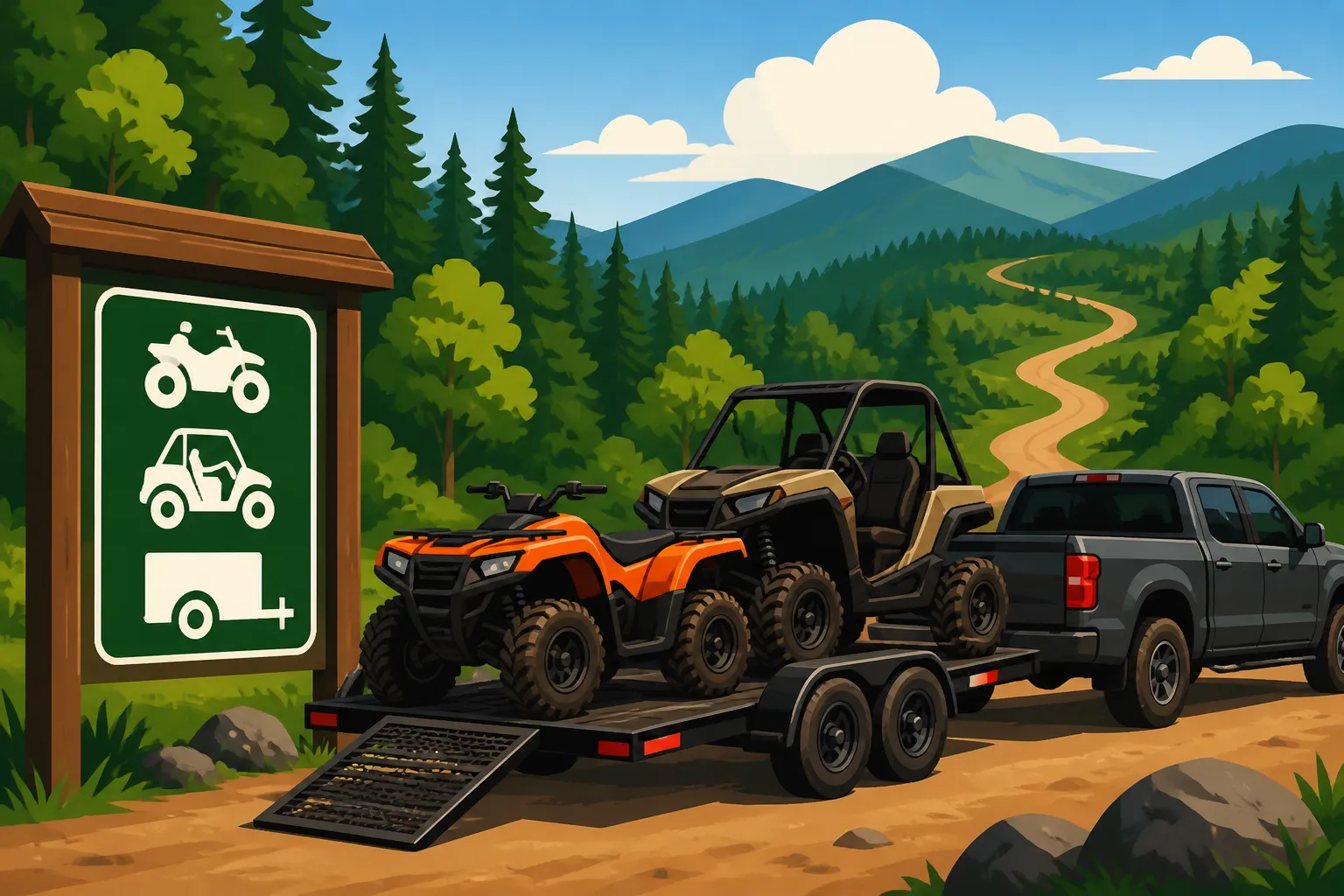
Think through the unloading sequence, too. You need enough room to park, lower ramps, roll the machine off, and move the truck without putting people or equipment in the travel lane. If you carry more than one ATV or UTV, account for the space needed to unload each machine and organize gear. A tight spot can become stressful quickly when another vehicle arrives behind you.
Ask about the surface and grade as well as the size. A gravel lot may be straightforward in dry weather but harder to manage after heavy rain. A sloped area can complicate loading, unloading, and parking a trailer securely. If your rig is large or you are traveling with a group, get a clear answer about whether the lot can accommodate multiple tow vehicles and trailers at the same time.
Check the approach route and the day’s conditions
A trailer-friendly lot is only useful if you can reach it safely. Review the final miles of the route for narrow lanes, steep grades, tight bends, low branches, and places where passing or turning around may be difficult. Mountain roads can feel very different when towing than they do in a car, particularly if you are arriving after dark or in wet weather.
Check for closures, construction, seasonal access changes, and recent weather concerns before you set out. A route that looks reasonable on a screen may include a road unsuitable for your rig or a section that is temporarily unavailable. The trail system or land manager is the best place to confirm official access information. A navigation app such as onX Offroad can help you plan, but it should not be the sole authority for whether a road is open or appropriate for towing.
If conditions are uncertain, plan a fallback. That might mean calling before you leave, choosing a different designated access point, or changing the riding day. Avoid improvising by leaving a trailer in an unmarked pull-off or blocking a gate, driveway, or emergency access. [Virginia Trail Conditions Before You Haul] is especially relevant when weather or road conditions could change the trip.
A practical trailer-parking plan for ride day
Confirm access, permits, and parking rules together
Make one call or check with the official information channel for the riding area, then confirm three things in the same conversation: where to park, whether your trailer is allowed there, and what you need to ride. A trail permit does not automatically grant permission to park anywhere nearby, and a parking space does not mean the riding area is open or that you have met its entry requirements.
Write down the name of the access point and any instructions you receive. Save the address or coordinates in your phone, but keep a second way to navigate if cell service is unreliable. Download or save relevant maps before you enter a mountain dead zone, and carry a written note with the trail system’s contact information and the directions to your intended lot.
For trails with digital permits or online verification, prepare before arrival rather than assuming you will have a reliable signal at the entrance. Review [Virginia Permit Checks on the Trail] and [Virginia Rules for a Rider Under 18] if your group includes younger riders. Requirements can differ by system, so verify them for the place you are actually visiting.
Arrive prepared to park without blocking anyone
When you reach the staging area, follow posted instructions and park only where permitted. Leave room for other trucks and trailers to enter, turn, unload, and exit. Do not use a gate, access road, turnaround, or emergency lane as overflow parking, even if the lot looks full. If there is no appropriate space, contact the operator or use a confirmed alternative rather than squeezing into a questionable spot.
Before unloading, check that the trailer is stable and that ramps have a safe landing area. Keep children and pets away from moving vehicles, and avoid letting equipment spill into the route used by other riders. If your group is arriving in several rigs, agree in advance on where to meet and how to avoid taking up more space than necessary.
Finally, make the return plan as carefully as the arrival plan. Note the lot’s closing rules, any gate or access restrictions, and how long it will take to load before dark. If the machines need to be washed or secured afterward, plan for that before you leave home. [Virginia Trailheads With Trailer Parking] can help you keep the parking question central as you compare destinations, but the final check should always be for the specific access point and travel date.
Disclaimer
This article is for general informational purposes only and does not constitute professional advice. Laws, prices and regulations vary by location and change over time. Consult a qualified professional for guidance on your specific situation.