Best Virginia ATV Trails for Beginners
Finding a beginner-friendly ATV trail in Virginia can be harder than picking a destination: a route that looks easy on a map may feel steep, rocky, or narrow from the seat. This guide compares approachable places to ride, explains what to check before you haul your machine, and helps new riders choose a trail that fits their experience and vehicle.
Beginner-Friendly ATV Riding Areas in Virginia
Virginia’s most approachable riding options tend to be managed trail systems with clear route markings, published difficulty levels, and rules you can check before setting out. That doesn’t mean every trail in a system is beginner-friendly. A comfortable first ride usually means choosing a short, easier route and being willing to turn around if conditions change.
Spearhead Trails in Southwest Virginia
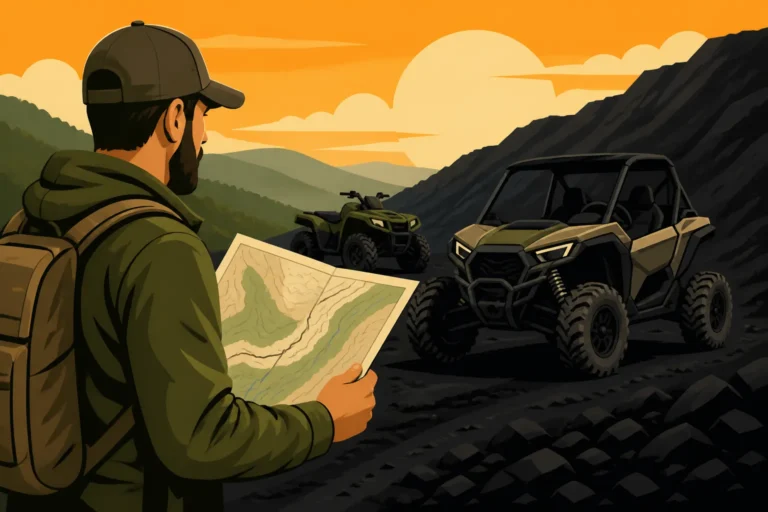
Spearhead’s trail systems in Southwest Virginia are a practical place for many beginners to start because routes are marked by difficulty. Coal Canyon, near Grundy, is one option to explore, while Mountain View, near Coeburn, and other Spearhead systems offer different terrain and trail choices. Check the current trail map and operator information before choosing a system, since route access, conditions, and available options can vary.
Pay attention to the difficulty rating rather than judging a route by its name or mileage. Green routes are generally intended to be easier than blue or black routes, but “easier” doesn’t mean flat, smooth, or risk-free. A beginner can still encounter loose rock, steep grades, ruts, or a tight turn. Review [Virginia Trail Difficulty Ratings] and [Spearhead Trails in Virginia Explained] before deciding where to ride.
It also helps to make your first outing short. A new rider who plans a modest loop has more room to build confidence, take breaks, and return to the trailhead before fatigue sets in. If you’re riding with friends who have more experience, agree in advance that the group will stay together and choose routes that work for the least experienced rider.
Peters Mill Run and Taskers Gap
Peters Mill Run and Taskers Gap, in the George Washington National Forest near Edinburg, provide a different kind of experience from the managed Spearhead systems. The area is popular with off-highway vehicle users, but forest roads and trails can feel rougher than a beginner expects. Rock, mud, changing weather, and seasonal closures all affect how manageable a route feels on a given day.
Don’t assume that a forest trail is easy because it looks like a road on a map. Review the official forest information for access rules, equipment requirements, and closures, and read [Peters Mill Run OHV Trails in Virginia] before you go. Taskers Gap has a width limit for machines on the relevant trail, so confirm that your ATV or side-by-side fits the rules. A machine that is too wide can turn an otherwise well-planned trip into a wasted drive.
For a first visit, go with someone who knows the area or choose a clearly defined route that matches your ability. If rain has recently passed through, a trail that might have been manageable in dry weather can become slick, muddy, or deeply rutted. Check [Virginia Trail Conditions Before You Haul] and [Virginia Trail Closures and Seasons] close to your departure.
How to Compare Virginia Riding Options
Use the comparison below as a planning starting point, not as a guarantee about how a particular trail will ride. Conditions and access can change, and the same route may feel very different after rain or heavy use.
| Riding area | What may suit a beginner | What to check before leaving |
|---|---|---|
| Coal Canyon near Grundy | Marked routes and a range of difficulty levels within the Spearhead system | Current route status, difficulty, permit rules, and the right trail map |
| Mountain View near Coeburn | A managed system with routes to compare by rating | Current access, route difficulty, and whether your machine is allowed |
| Peters Mill Run near Edinburg | A forest OHV destination for riders who are comfortable with a more natural trail surface | Seasonal closure, forest rules, equipment requirements, and current conditions |
| Taskers Gap near Edinburg | An option for riders who have checked the route and machine-width requirements | Width limits, route access, and whether the trail fits your vehicle |
A useful next step is to compare your machine with the riding area’s vehicle rules. Some routes are appropriate for ATVs but not wider side-by-sides, while others have restrictions that apply to particular vehicle types. See [Virginia Trails That Allow Side-by-Sides] before you pick a destination.
Choose a Trail That Matches Your Experience
A “beginner trail” is not one universal thing. A rider who is comfortable with a small youth quad may have different needs from someone learning on a full-size ATV or a side-by-side. The best choice is the route that gives you room to ride calmly and safely—not the one that makes the biggest claim on a trail map.
Read Difficulty Ratings Carefully
Trail ratings are helpful, but they’re only one part of the decision. Consider what the rating says about the route’s overall challenge, then look for details about surface, elevation, width, and obstacles. A route with a low difficulty rating may still have a section that feels intimidating to someone who has never ridden on gravel or uneven ground.
Think through a realistic scenario: you’re new to riding, your group reaches a rocky climb, and the rider ahead goes up without trouble. That doesn’t automatically mean you should follow. Stop somewhere safe, check the route, and decide whether you’re comfortable with the slope and surface. You can always pause or turn around. There’s no prize for keeping up with the most experienced rider.
If the trail system offers a map with marked difficulty levels, use it to plan a route with clear alternatives. Check whether a route connects to more difficult trails, and be especially cautious at junctions. A wrong turn can take a relaxed outing into terrain you didn’t intend to ride. A navigation app such as onX Offroad can help you review a route and keep track of your position, but compare its map with the riding area’s official information before relying on it.
Match the Route to Your ATV or UTV
Your vehicle affects which trails are available to you. Width matters, especially for side-by-sides. So do turning space, ground clearance, and the machine’s ability to handle the trail surface. Before leaving home, verify that your vehicle is permitted on the route and meets any trail-system requirements. Don’t rely on a seller’s description or a friend’s memory when the riding area publishes its own rules.
A new rider should also think about how the machine feels at low speed. If steering, braking, or controlling the throttle still takes concentration, a narrow trail with sharp turns may be stressful even if it has a beginner rating. Spend time getting comfortable in a legal, appropriate practice area before attempting more demanding routes. For youth riders, confirm that the vehicle is suitable for the rider and that the riding area’s age and supervision rules are followed.
For navigation, save or download the information you’ll need before you lose cell coverage. onX Offroad may be useful for reviewing your route and checking your location, but it should be a backup to—not a substitute for—trail-system maps, posted signs, and ranger or operator guidance. If an app and a posted closure disagree, follow the closure and ask the trail operator for clarification.
Know When to Turn Around
One of the best beginner skills is recognizing when a trail no longer feels manageable. Mud may be deeper than expected, a slope may be steeper than it looked from below, or a fallen branch may block the route. If you’re uncertain, stop in a safe place and talk it through with your group rather than trying to push through because you’ve already come this far.
Fatigue is another good reason to shorten a ride. New riders often grip the bars tightly, tense their shoulders, and concentrate hard on every bump. That’s normal, but it can make a long day exhausting. Plan breaks, drink water, and keep enough daylight and energy for the return trip. A short ride that ends with everyone wanting to come back is a better first outing than a long ride that leaves the group worn out.
Plan Your First Virginia ATV Ride
Good planning takes the pressure off when you reach the trailhead. You’ll know where you intend to ride, what the rules require, and what to do if the route is closed or the weather turns. It also helps prevent the frustrating situation of towing your ATV or UTV for hours only to discover that your chosen trail isn’t suitable for your machine.
Check Permits, Access, and Local Rules
Different riding areas can have different permit and access requirements. Confirm what applies to your destination, how the permit must be displayed or verified, and whether any rules apply to minors or passengers. Start with [Virginia Trail Permits] and the official information for the specific riding area. Don’t assume a permit for one system covers another.
Virginia’s public-land rules also matter. A place that looks like an open trail on a phone map may cross land where motorized riding is not allowed. State parks, forest land, private riding parks, and managed trail networks do not all have the same access policies. Confirm that the route is open to your vehicle and that you have permission to ride there.
Before leaving, check for closures, weather-related notices, operating hours, parking arrangements, and any equipment rules. Save useful information offline in case service drops. onX Offroad can be one planning aid, but it cannot replace current notices from the land manager or riding-area operator. If access information is unclear, call or check the official channel before you load the trailer.
Pack for the Trail and the Return Trip
Bring the safety gear required by the riding area and Virginia law, and make sure it fits properly before the day of the ride. A helmet that shifts around or eye protection that fogs easily can distract you when you need to focus on the trail. Dress for changing mountain weather, even if the forecast looks comfortable at home.
Your basic plan should include water, a charged phone, a first-aid kit, a way to identify your trailhead, and enough fuel for the route and a margin for unexpected detours. If you use a phone for navigation, download maps ahead of time and bring a backup charging option. A paper map is also useful when a device battery dies or a signal disappears.
Tell someone who isn’t riding where you’re going and when you expect to return. If you’re riding with a group, agree on regrouping points and what to do if someone gets separated. Keep the pace comfortable, stay on designated routes, and avoid riding beyond your vehicle or skill level. For more practical trail manners, read [Virginia Trail Etiquette Locals Expect].
Make the Drive Home Part of the Plan
The ride doesn’t end when you reach the parking area. Leave time to secure your machine, check your trailer, and make sure everyone is rested enough for the drive. If you’ve been riding in mud or rain, consider how the machine will be loaded and whether loose gear needs to be cleaned or secured first.
If you’re staying overnight, look for lodging or camping that explicitly allows the kind of vehicle and trailer you’re bringing. Don’t assume that a nearby campground permits ATV use or offers a trail connection. [Virginia OHV Camping With Trail Access] can help you think through that part of the trip.
Finally, keep your route notes. After the ride, write down what felt easy, what felt challenging, whether the machine fit comfortably, and which junctions were confusing. That small habit makes it much easier to choose a suitable route next time. You may discover that a trail you initially avoided feels approachable after more practice—or that a different system is a better match for your vehicle and riding style.
Common Beginner Mistakes to Avoid
A little caution can prevent a stressful first outing. Beginners don’t need to know every trail system by heart, but they do benefit from avoiding a few predictable planning mistakes.
Don’t Choose a Route by Mileage Alone
A short route can still be challenging if it includes steep grades, loose rocks, narrow turns, or a difficult surface. A longer route may feel easier when it’s wide, gradual, and clearly marked. Look at the difficulty rating and terrain details, not just the distance shown on a map.
Also, be wary of planning around a single online map or an old recommendation. Trail access changes, weather affects surfaces, and posted closures take precedence over a route shown in an app. Use onX Offroad or another map to support your planning, then confirm the route with the trail operator before heading out.
Don’t Let the Group’s Fastest Rider Set the Pace
It’s easy to feel pressured when friends move quickly or treat a route as familiar. Tell the group beforehand that you’re new and need a pace that lets you ride in control. Ask experienced riders to wait at junctions and regroup points, rather than disappearing ahead and leaving you to guess which way to go.
If your group won’t adjust to your comfort level, consider choosing a different ride or going with someone who will. A beginner-friendly outing should leave you enough attention to steer, brake, watch the surface, and make decisions. Riding faster than you can comfortably manage is not a useful shortcut to experience.
Don’t Treat a Trail App as Permission to Ride
A mapped line doesn’t necessarily mean a trail is open, legal for your vehicle, or appropriate for a novice. Access rules can differ by land manager, vehicle type, and route. A map can help you understand where you are, but signs and official instructions determine where you may ride.
Check the riding area’s rules before you go, obey closures, and stay on designated routes. If a posted sign conflicts with your planned route, stop and follow the sign. When you’re unsure whether a route is open to your ATV or UTV, ask the operator rather than guessing.
Disclaimer
This article is for general informational purposes only and does not constitute professional advice. Laws, prices and regulations vary by location and change over time. Consult a qualified professional for guidance on your specific situation.