Virginia Rules for a Utility Vehicle on a Farm
Navigating the rules and regulations for using a utility vehicle (UTV) on a farm in Virginia can feel like trying to plow a rocky field – you know there's a path, but it's full of hidden snags and confusing directions. Many farmers and landowners just want to get work done without inadvertently breaking the law or risking penalties. This guide is here to clear the mud, explaining exactly what Virginia law says about operating your UTV for agricultural purposes, both on your land and when you need to cross public roads.
Understanding Virginia's Farm Use Exemptions for UTVs
When you're running a farm, your utility vehicle isn't just a toy; it's a vital piece of equipment, often as essential as your tractor or pickup truck. The good news is that Virginia law recognizes this operational reality, providing specific exemptions and rules for UTVs used exclusively for agricultural purposes. However, these rules come with some important caveats that every farmer needs to understand to avoid problems.
What Qualifies as a "Utility Vehicle" in Virginia for Farm Use?
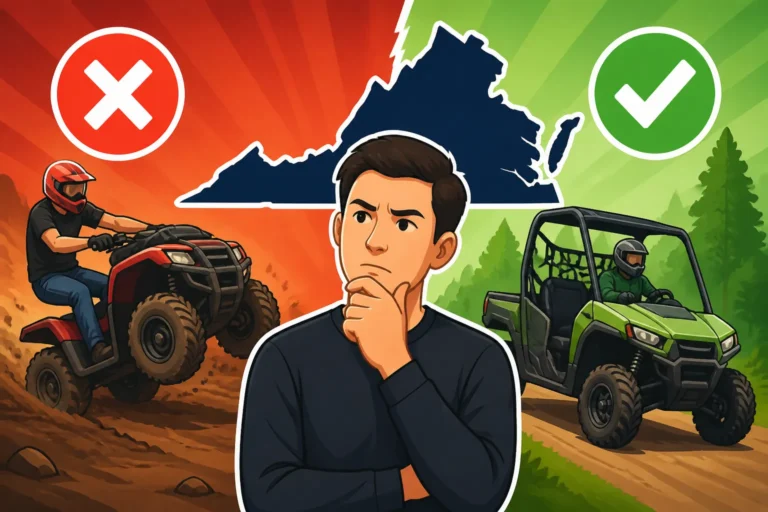
First off, let's get clear on what we're talking about. In Virginia, a "utility vehicle" (often shortened to UTV, side-by-side, or SXS) is generally defined by its design: it's typically an off-road vehicle with a steering wheel, side-by-side seating, and a cargo bed, designed for utility work rather than pure recreation. This is distinctly different from an all-terrain vehicle (ATV), which usually has a straddle seat and handlebars. For farm use, the key isn't just the design, but the purpose.
The law is less concerned with the brand of your machine – whether it's a John Deere Gator, a Polaris Ranger, or a Kubota RTV – and more with how it's being employed. If your side-by-side is primarily used for tasks like hauling feed, fence repair materials, tools, checking on livestock, or transporting crops around your property, it falls squarely into the "farm use" category in spirit, even if the general vehicle definition might overlap with recreational uses elsewhere. The distinction is crucial because it unlocks specific legal allowances.
The Core of the Farm Use Exemption
The heart of the farm use exemption in Virginia lies in recognizing that agricultural operations often require movement of machinery that isn't street-legal in the traditional sense. For a UTV, this means that if it's being used exclusively for farm purposes on private farmland, many of the typical requirements for motor vehicles simply don't apply. This includes things like titling, registration, and inspection. Think about it: you don't title your wheelbarrow or register your hay baler, because they're farm equipment. A UTV, in this context, is often viewed similarly.
This exemption is incredibly helpful for farmers, allowing them to focus on their work rather than bureaucratic hurdles for every piece of equipment. It acknowledges the unique environment of a farm where vehicles move between fields, barns, and pastureland without ever touching a public road. However, it's critical to remember that "exclusively for farm purposes" is the lynchpin. If you start using that UTV for weekend trail riding that isn't connected to your farm operation, you could lose the benefit of these exemptions. It's not a free pass to ignore all vehicle laws; it's a targeted exemption for a specific, essential use case.
Restrictions on Public Road Access
Here's where many farmers hit a roadblock (pun intended). While your UTV might be exempt from titling and registration for farm use on your private land, that doesn't automatically mean you can drive it on public roads, even short distances. Virginia law is very clear on this: ATVs and UTVs are generally prohibited from operating on public highways.
However, there is a specific, limited exception for farm machinery. A UTV used for farming may cross a public highway by the most direct route. This means driving straight across the road from one section of your farm to another, or from a field to a barn across the street. What it absolutely does not mean is driving down the road, even for a short distance, to get to the next farm or to run into town for supplies. That's a common misconception that can lead to a hefty fine. The intent is to facilitate farming operations that span both sides of a public road, not to provide an alternative to a registered vehicle. This crossing must be done with extreme caution, yielding to all traffic, and often limited to daylight hours. [Virginia Crossings by the Most Direct Route] further details this specific provision.
Practical Application: Using Your UTV on Virginia Farmland and Roads
So, you've got your UTV, and you're ready to put it to work. Beyond understanding the legal definitions, there are practical steps and considerations to ensure you're operating safely and legally, especially when your farm operations require you to interact with public infrastructure. It's about blending efficiency with compliance.
Necessary Documentation for Farm Use
Even if your UTV isn't titled or registered because it's exclusively for farm use, it's wise to carry some basic documentation, especially if you ever need to cross a public road or if a law enforcement officer has questions. The most important document is proof of ownership, like a bill of sale. This confirms the machine belongs to you and isn't stolen. If you originally purchased it new and received a Manufacturer's Statement of Origin (MSO), keep a copy of that as well. While [Virginia Titles Are Optional on Used Machines], having any original purchase paperwork can be incredibly helpful for establishing ownership.
Some farmers even opt to get a Virginia title for their UTV, even if not strictly required, purely for the paper trail and proof of ownership it provides. This can be particularly useful if the UTV is financed, or if you plan to sell it later. While a full registration isn't issued, having a title provides a clear record with the state. [Virginia Paperwork for a Farm Utility Vehicle] delves deeper into the specific documents you might need or find useful. This simple step can save you a lot of headache down the road if there's ever a question about who owns the machine.
Crossing Public Roads: The "Direct Route" Rule
As mentioned, the "most direct route" rule is your one public road allowance. Imagine your farm fields are on both sides of a state route. You can drive your UTV straight across that road to get from one field to the other. But what does "most direct" truly mean in practice? It means the shortest possible path, typically perpendicular to the flow of traffic. It does not mean driving down the shoulder for a quarter-mile to reach your next pasture gate. That's a critical distinction.
When crossing, treat your UTV like any slow-moving farm equipment. Use turn signals if your UTV has them, or clear hand signals. Yield to all oncoming traffic. The goal is to minimize your time on the public road as much as possible for everyone's safety. And remember, this exception only applies when you are actively engaged in farm work. If you're just joyriding or heading to a neighbor's house for a visit, that exception vanishes, and you could be ticketed for illegal operation on a public highway. Many rural areas in Virginia have narrow roads and blind curves, so extreme vigilance is always necessary.
Safety Considerations and Equipment
While specific equipment mandates for farm-use UTVs are minimal, prioritizing safety is just good sense. You're often working alone in remote areas, hauling heavy loads, or traversing uneven terrain. Many UTVs, especially modern ones, come with roll-over protection structures (ROPS) and seatbelts. Always use them. Even if you're just moving slowly, a tip-over can happen quickly on a sloped field or with an unbalanced load, and the consequences can be severe.
Consider adding aftermarket safety features that make sense for your specific farm tasks. For example, a sturdy winch from a company like SuperATV can be invaluable for pulling out stuck equipment or clearing downed trees. Good lighting, even for daytime use, can increase visibility to others, especially during those legal road crossings. Reflective tape on the back of your UTV is also a smart, low-cost addition to make your machine more visible to fast-moving vehicles on public roads, even when you're just crossing. Investing in proper tires for your terrain, whether it's mud, rocks, or pasture, also contributes significantly to safe operation.
Titling, Taxes, and Other Paperwork for Farm UTVs
Even with the farm use exemptions, there are still aspects of ownership and operation that can involve the Virginia Department of Motor Vehicles (DMV) or tax authorities. Understanding these nuances can help you leverage available benefits and avoid unexpected costs or compliance issues.
When a Title Might Still Be Needed
As we discussed, a title isn't always required for a UTV used exclusively for farm purposes. However, there are compelling reasons why many farmers choose to get one anyway. A title provides indisputable proof of ownership, which is incredibly important if your UTV is ever stolen. Without a title, proving ownership can be a much more complicated and drawn-out process.
Furthermore, if you ever plan to sell your UTV, especially to someone who won't be using it exclusively for farm purposes (e.g., a recreational rider), having a clear title makes the sale much smoother. Many buyers will be hesitant to purchase a machine without a title. If you finance your UTV purchase through a bank or credit union, the lender will almost certainly require you to title the machine so they can record their lien against it. So, while the law might not force you, good practice and financial realities often lead farmers to title their machines. [Virginia Title for a Utility Vehicle] offers more details on the titling process.
Sales Tax Exemptions for Farm Equipment
One of the most significant financial benefits for farmers buying a UTV is the potential for sales tax exemption. In Virginia, purchases of certain tangible personal property used directly in agricultural production for market are exempt from sales and use tax. This means if you're buying a UTV (or a new set of heavy-duty axles from SuperATV) specifically and exclusively for your farming operation, you might not have to pay the state's sales tax on that purchase.
To qualify, you'll typically need to provide proof to the dealer that you are engaged in farming for market. This usually involves completing a Virginia Sales and Use Tax Exemption Certificate for Agricultural Production (Form ST-18A). You can't just verbally claim the exemption; it requires the correct paperwork. It's crucial that the UTV truly is for direct farm production. If you plan to use it for personal recreation or other non-farm activities, it may not qualify, and misrepresenting its use could lead to penalties. [Virginia Farm Tax Exemption for a Quad] has more information on this valuable tax saving.
Insurance for Your Farm UTV
Virginia law does not require you to carry insurance on an ATV or UTV, even if it's titled. However, this lack of a legal mandate absolutely does not mean you should skip insurance. A UTV accident, even on your own property, can result in significant medical bills for yourself or others, or substantial property damage. Without insurance, you'd be personally responsible for all these costs.
Consider liability insurance to protect you if your UTV injures someone or damages property, as well as comprehensive and collision coverage to protect your investment in the machine itself. A UTV is a significant asset, and it can be stolen, catch fire, or be damaged in an accident. Many farm insurance policies can include coverage for UTVs as part of your broader farm liability or equipment coverage, or you can purchase a standalone policy. It's always best to discuss your specific needs with an insurance agent familiar with farm operations to ensure you have adequate protection. [Why Virginia Requires No ATV Insurance] explains why the state doesn't mandate it for off-road machines.
Common Pitfalls and Misconceptions
Despite the clear legal framework, there are still misunderstandings that can lead farmers into trouble. Many of these issues stem from confusing the specific farm use exemptions with general vehicle laws or misinterpreting the scope of "farm work." Avoiding these common traps is key to headache-free UTV operation.
Confusing Farm Use with Recreational Use
This is perhaps the biggest pitfall. The special exemptions for UTVs are strictly for machines used "exclusively for agricultural production for market." As soon as your UTV leaves the realm of farm work and enters recreational territory – whether it's trail riding on a nearby public trail system, visiting friends on neighboring properties for fun, or taking it hunting when it's not directly related to managing your land as a farm – those exemptions generally disappear.
For instance, if you take your "farm UTV" to the [Spearhead Trails in Virginia Explained] for a weekend ride, you'll need to ensure you comply with their permit requirements and all standard off-road vehicle laws, regardless of its primary use back on the farm. Thinking that a farm use exemption carries over to recreational activities is a common mistake. If an officer stops you off the farm on a public road or trail and you're not actively engaged in a permitted farm crossing or specific farm work, you could be cited. Your machine's primary purpose might be farming, but its current use dictates the applicable laws.
Local Ordinances and Their Impact
While Virginia state law provides the overarching framework, local county and city ordinances can sometimes add another layer of complexity. Some localities might have their own specific rules regarding the use of off-road vehicles, including UTVs, particularly if they are perceived as a nuisance or safety hazard. For agricultural operations, these are less common on private land, but it’s always worth checking with your local county government or sheriff's office if you have any doubts about a specific situation or area.
For example, while the state allows crossing a public road, a very dense suburban county bordering a rural area might have stricter enforcement or different interpretations of "most direct route" due to higher traffic volumes. While state law generally preempts local ordinances for agricultural practices on private land, it's always better to be informed and proactive. Most farming activities are well-understood and accommodated, but unique situations or new developments sometimes warrant a quick call to a local official.
Enforcement and Penalties
Ignoring the rules for farm UTVs can lead to various penalties, which can range from civil fines to impoundment of your vehicle. Operating a UTV on a public highway when not performing a legal farm crossing, for instance, could result in a civil penalty. These aren't minor tickets; they can add up, and if your UTV is impounded, getting it back can be a costly and time-consuming process. [Virginia Penalties for Illegal Riding] illustrates the financial consequences for ATV/UTV violations.
Law enforcement officers in rural areas are often familiar with agricultural practices, but they are also responsible for public safety. If they observe a UTV being used unsafely or illegally on a public road, they will act. It's your responsibility as the operator to know and follow the rules. If you're unsure about a particular scenario, it's always better to err on the side of caution or seek clarification from the DMV or a legal professional before operating in a grey area. A little research upfront can save you a lot of grief and expense later on.
Disclaimer
This article is for general informational purposes only and does not constitute professional advice. Laws, prices and regulations vary by location and change over time. Consult a qualified professional for guidance on your specific situation.