Virginia Age Limits by Engine Size
Navigating the often-confusing world of ATV and UTV regulations for young riders in Virginia can feel like trying to find your way through a dense Appalachian forest without a map. Many parents are left scratching their heads, wondering if their child's quad is truly legal for them to operate, especially when engine size comes into play. This guide aims to clear up that confusion, diving deep into Virginia's specific age limits as they relate to engine displacement, helping you ensure your young rider stays safe and on the right side of the law.
Understanding Virginia's Core Age and Engine Size Rules
Virginia's approach to ATV and UTV operation for minors is primarily dictated by age and engine size, a direct measure designed to match a rider's physical and developmental capabilities with the power and weight of the machine. It’s not about how skilled your child is, or how long they've been riding; it’s a hard-and-fast rule based on the numbers. This can be a tough pill to swallow for parents who see their young daredevil competently handling a larger machine in the backyard, but the law doesn't make exceptions for perceived talent.
The Virginia Code lays out these provisions to protect young riders, acknowledging that a machine that is too powerful or heavy for a child can quickly become a serious hazard. These aren't just arbitrary rules; they're rooted in decades of ATV safety data and accident statistics. Ignoring them doesn't just put your child at risk, it also opens you up to significant legal penalties, including civil fines and potential liability in the event of an accident. It's crucial for every parent and guardian to grasp these foundational concepts before letting a child operate an ATV or UTV in the Commonwealth.
Riders Under 12 and the 70cc Rule
For any child under the age of 12, Virginia law is quite clear and unwavering: they cannot operate an ATV with an engine displacement greater than 70 cubic centimeters (cc). This 70cc threshold is a strict maximum, regardless of the child's height, weight, or apparent riding prowess. It's a common frustration for parents, especially those with naturally taller or more experienced young riders who might easily handle a 90cc or even 125cc machine designed for older children. However, the law makes no allowances for these individual differences.
Imagine you have a very capable 10-year-old, "Casey," who has been riding a small ATV since they were six. Casey can effortlessly navigate trails on their 90cc quad in your private field. However, if Casey were to ride that same 90cc quad on public lands, such as the Spearhead Trails system, or even on a neighbor's property with permission, they would be in direct violation of Virginia law. A trail ranger or law enforcement officer, seeing an underage rider on an oversized machine, would be compelled to intervene, likely resulting in a citation for the supervising adult. This is where knowing the rules inside and out, as detailed in [Virginia Riders Under 12 and 70cc], becomes incredibly important.
The rationale behind the 70cc limit for this age group is primarily safety. Younger children simply lack the physical strength, coordination, and cognitive maturity to safely control larger, more powerful machines, especially when faced with unexpected terrain changes or emergency maneuvers. A bigger engine means more torque, more speed, and often a heavier machine, all of which amplify the risks for a small operator. Even on private land, where enforcement might be less direct, adhering to this limit is a best practice for minimizing the risk of serious injury.
The 12 to 16 Age Bracket and the 90cc Limit
Once a rider celebrates their 12th birthday, the allowable engine size for their ATV increases slightly. From the age of 12 up to their 16th birthday, a young person in Virginia may operate an ATV with an engine not exceeding 90cc. This marks a significant developmental step, acknowledging that pre-teens and younger teenagers generally possess greater physical development and improved judgment compared to their younger counterparts. It allows for a natural progression in skill and machine capability without jumping directly to adult-sized vehicles.
This transition period often sees riders moving from entry-level youth models to more robust youth ATVs. Many manufacturers design specific 90cc models with features suited for this age group, such as electric start, automatic transmissions, and adjustable throttles to limit speed. Parents seeking accessories or parts to make these machines fit their growing rider more effectively might explore options from companies like SuperATV, which offer a range of products to customize machines for safety and comfort. However, even with these advancements, the 90cc cap remains firm until the rider turns 16.
Consider a 14-year-old, "Jamie," who enjoys riding their 90cc sport quad on designated trails. Jamie has their [Virginia Spearhead Trail Permits] and always wears a helmet. One day, Jamie decides to try out a friend's 125cc machine, thinking the small difference wouldn't matter much. If caught by an officer or trail ranger, Jamie (and their supervising adult) would be in violation, as a 14-year-old cannot legally operate anything over 90cc in Virginia. It's a critical distinction, highlighted further in [Virginia Riders 12 to 16 and 90cc], emphasizing that even a small increase in engine size beyond the limit can lead to legal trouble.
The "No Cap After Sixteen" Rule and Its Nuances
Upon reaching their 16th birthday, an ATV rider in Virginia is no longer restricted by specific engine size limits. At this point, they are legally permitted to operate any size ATV, including the powerful, adult-sized machines that exceed 90cc. This freedom from engine displacement restrictions is a significant milestone for young riders, opening up a much broader range of vehicles, from high-performance sport quads to large utility ATVs and side-by-sides. However, this increased privilege comes with an implicit expectation of greater responsibility and adherence to all other Virginia ATV laws.
While the engine size restriction lifts, it's crucial to remember that all other safety and operational laws still apply. A 16-year-old rider, for instance, must still wear an approved helmet, just like every other rider in the Commonwealth. [Virginia Helmet Law Applies to Every Rider] is not something that suddenly becomes optional. They also must respect property rights, avoiding trespassing, and understand that Virginia generally prohibits ATVs on public highways and streets. The "no cap" rule simply means the machine's engine size is no longer a legal barrier to operation for that individual.
For example, "Michael" just turned 16 and is thrilled to finally ride the family's 450cc sport quad. He's been dreaming of this day for years. While he can now legally operate that machine, he still needs to ensure he's riding on legal terrain, perhaps at a private off-road park or on a Virginia trail system like those in the coalfields, where he has a permit. If Michael were to take that 450cc quad onto a paved county road for a quick spin, he would be violating different sections of the Virginia Code regarding public highway use, not the engine size rule. This progression, culminating in [Virginia Riders 16 and Over], signifies a full transition to adult riding responsibilities.
Distinguishing ATVs from UTVs for Age Limits
It’s important to clarify that while the age limits apply broadly to "all-terrain vehicles," there's a practical distinction when it comes to utility task vehicles (UTVs) or side-by-sides. Virginia defines ATVs specifically, and UTVs often fall under the broader umbrella of off-road vehicles. However, the spirit of the law, especially concerning minor operators, generally extends to these machines as well, particularly for safety reasons. While the strict 70cc/90cc engine limits are often associated with traditional sit-astride ATVs, the concept of matching machine capability to rider maturity is paramount for UTVs too.
For side-by-sides, which often have higher horsepower, heavier frames, and features like roll cages and seatbelts, the primary concern for minors shifts slightly. While a 10-year-old cannot operate a powerful UTV due to its sheer size and engine capacity, the specific engine displacement limits might not be as explicitly enforced as they are for ATVs. Instead, manufacturer age recommendations, often displayed on the machine or in the owner's manual, become extremely important. Most UTV manufacturers recommend operators be at least 16 years old for full-size models, or 10-12 for youth-specific UTVs designed with reduced speed and power.
Parents of young UTV operators should therefore prioritize manufacturer guidelines in addition to the state's ATV age and engine size rules. If a UTV is labeled for ages 16 and up, allowing a 14-year-old to drive it, even with parental supervision, creates a significant liability risk and goes against safety best practices. Always defer to the most restrictive age recommendation, whether it's from the state code or the manufacturer, when making decisions for [Virginia Youth Permit Rules] or allowing operation of any off-road vehicle.
Parental Supervision and Its Role in Virginia Law
One of the most common questions and biggest areas of misconception among parents is how supervision affects Virginia's ATV age and engine size limits. Many states have provisions that allow a younger rider to operate a larger machine if they are under the direct supervision of an adult. However, Virginia law, as currently written, does not include such an "escape clause" or supervised exception. This means that the age and engine size limits are absolute; a child under 12 cannot operate an ATV over 70cc, and a child between 12 and 16 cannot operate an ATV over 90cc, even if a parent is standing right next to them.
This aspect of Virginia law can be particularly frustrating for families, especially those coming from states with more lenient supervision rules. A parent might assume that as long as they are present and actively guiding their child, any machine is acceptable. This is a dangerous assumption and a direct path to legal trouble. Virginia places the responsibility squarely on the supervising adult to ensure the child is operating a machine that falls within their legally prescribed age and engine size bracket. This is a critical point that differentiates Virginia from many other states.
Consider "Sarah," a mom who moved to Virginia from a neighboring state where her 11-year-old, "Ben," regularly rode their 125cc ATV with her supervision. Upon moving to Virginia, Sarah assumes the same rules apply. She takes Ben and his 125cc quad to a local riding area. A conservation police officer observes Ben operating the machine. Despite Sarah being present and actively supervising, Ben is in violation of the 70cc rule for riders under 12. Sarah would likely face a civil penalty because, as explained in [Virginia Has No Supervision Escape Clause], her presence doesn't override the statutory age and engine size limits.
Consequences of Ignoring Supervision Rules
The absence of a supervision escape clause means that parents or guardians who allow a minor to violate the age and engine size restrictions are directly exposing themselves to legal and financial repercussions. The Commonwealth takes these rules seriously as a measure to prevent injury and death, especially among young riders. Violations are typically treated as civil infractions, carrying potential fines that can quickly add up, especially if repeated.
Beyond civil penalties, there's the much more serious issue of liability in the event of an accident. If a minor is injured while operating an ATV or UTV that is too large for their age under Virginia law, the supervising adult could face significant civil liability. Insurance companies might also deny claims if the machine was being operated in violation of state law, leaving the family to bear the full financial burden of medical expenses, property damage, or even lawsuits if another party was involved. Ensuring compliance isn't just about avoiding a ticket; it's about protecting your family's safety and financial well-being.
For instance, if Ben (the 11-year-old from the previous example) were to have an accident on his 125cc ATV, Sarah could face substantial legal challenges. Her ATV insurance policy might refuse to cover medical costs or property damage, arguing that the machine was being operated illegally by an underage driver for that engine size. This is why understanding [Virginia's Civil Penalty for Illegal Riding] and adhering strictly to the age and engine size mandates is paramount, whether you're riding on public trails or your own private property.
Age Limits on Virginia's Public Trails and Riding Areas
When riding on public lands, such as Virginia's popular Spearhead Trails system or the George Washington and Jefferson National Forests, the state's age and engine size limits are strictly enforced. These trail systems operate under specific regulations designed to ensure the safety of all users, and compliance with state law is a baseline requirement for entry and operation. Trail rangers and law enforcement officers regularly patrol these areas, checking for permits, safety gear, and adherence to age-appropriate machine operation.
The rules for riders under 18 often extend beyond just engine size when entering these trail systems. For example, Spearhead Trails requires that riders under 18 must be accompanied by a parent or legal guardian who also holds a valid permit. This parental presence is for supervisory purposes on the trail and does not, as previously discussed, override the fundamental age and engine size restrictions from the state code. Furthermore, trail systems often have their own internal rules regarding machine modifications or safety equipment that go above and beyond state minimums.
Let's consider "The Ridgeview Trail System," part of the Spearhead network. A family arrives with a 15-year-old, "Chris," who wants to ride his 200cc ATV. Even though Chris is 15, which allows him to operate up to 90cc, his 200cc machine is still too large for his age according to Virginia law. A trail ranger, upon checking Chris's permit and machine, would inform the family that Chris cannot legally ride that ATV on the trail. This situation, while frustrating, highlights how closely public riding areas like those detailed in [Spearhead Trails in Virginia Explained] align with and enforce state regulations.
Permit Requirements for Young Riders
In addition to state-mandated age and engine size limits, specific permit requirements apply to young riders on public trail systems like Spearhead. Spearhead Trails, for instance, offers a "Youth Permit" for riders under the age of 16. This permit is typically offered at a reduced rate compared to adult permits. However, purchasing a youth permit does not grant a child the right to operate any size machine; they must still adhere to the 70cc or 90cc engine size limits based on their age. The permit simply authorizes their presence on the trail system, assuming all other legal requirements are met.
For National Forest OHV trails, such as Peters Mill Run and Taskers Gap, while there isn't a specific "youth permit," all riders must possess a valid OHV permit. Again, the permit grants access to the trail, but the operator must still comply with Virginia's age and engine size statutes. It's a two-tiered compliance system: state law for the machine and operator, and then specific trail system rules for access and conduct. This layered approach ensures comprehensive safety coverage.
Imagine a family is planning a trip to Peters Mill Run. Their 11-year-old, "Lily," has a 70cc quad, which is perfectly legal for her age. Her parents purchase the necessary [Virginia National Forest OHV Permits] for themselves and Lily. When they arrive at the trailhead, a ranger might verify their permits and briefly check the machines. Lily's 70cc quad is fine. If, however, they had brought an 80cc quad for Lily, despite having a permit, she would not be allowed to ride it due to exceeding the 70cc age limit for an 11-year-old. The permit allows access, but the state law governs who can ride what machine.
Why These Rules Matter: Safety and Legal Consequences
The enforcement of age and engine size limits isn't about bureaucracy or making things difficult for families; it's fundamentally about preventing serious injuries and fatalities. ATVs and UTVs are powerful machines, and statistics consistently show that younger, smaller riders are at a significantly higher risk of accidents, rollovers, and severe injuries when operating machines beyond their physical and developmental capabilities. The rules are a proactive measure to protect the most vulnerable group of riders.
A machine that is too heavy can be difficult for a child to right after a tip-over, potentially trapping them. A machine that is too fast can lead to loss of control, especially when encountering unexpected obstacles or terrain changes. The physical demands of steering, braking, and shifting on an oversized ATV can quickly fatigue a young rider, impairing their judgment and reaction time. These are not hypothetical concerns; they are the grim realities of why these regulations exist. [Virginia Age Limits Set by Engine Size, Not by Supervision] is a direct response to these safety considerations.
Beyond the immediate safety concerns, violating these regulations can lead to a cascade of legal consequences for both the minor rider and the supervising adult. We've already touched on civil penalties, but the implications can extend to criminal charges in cases of severe negligence, denial of insurance claims, and significant personal liability. The financial and emotional toll of a severe accident, especially one that could have been prevented by adherence to a simple rule, is immeasurable.
Civil Penalties and Financial Implications
Virginia law is specific about the penalties for violating ATV regulations, including those related to age and engine size. An adult who permits a minor to operate an ATV in violation of these rules can face a civil penalty of up to $500 for each offense. This is not a trivial sum and can quickly become a heavy burden if multiple violations occur or if an incident leads to repeated citations. These penalties are designed to be a significant deterrent, emphasizing the state's commitment to youth rider safety.
Beyond the initial civil fine, the financial implications can grow exponentially if an accident occurs. As mentioned, insurance policies might be nullified if the ATV was being operated illegally. This means parents could be on the hook for hefty medical bills, property damage to their own machine or others' property, and even legal defense costs if they are sued. For instance, if a young rider on an oversized ATV loses control and damages a fence on a neighbor's property, the uninsured repair costs and potential legal fees could be devastating.
Therefore, the decision to allow a child to ride a machine outside of the legal age and engine size limits carries substantial financial risk. It's a calculated gamble that few families can afford to lose. Understanding the potential financial exposure, including [Virginia's Civil Penalty for Illegal Riding], should serve as a powerful motivator for strict compliance with all Virginia ATV laws.
Common Misconceptions About Virginia ATV Age Limits
It’s easy to get confused by ATV laws, especially when rules differ from state to state or from what we might "feel" is appropriate for our child. One of the biggest misconceptions in Virginia, as we've already discussed, is the idea that adult supervision can override the statutory age and engine size limits. This is simply not true in Virginia; supervision doesn't change the letter of the law. Another common mistake is assuming that manufacturer age recommendations are legally binding in Virginia when state law has its own, sometimes stricter, guidelines. While manufacturer guidelines are excellent safety tools, state law takes precedence when it comes to legal operation.
Another area of confusion often stems from the distinction between private and public land. Some believe that these age and engine size limits only apply on public trails or roads, and that on their own private property, anything goes. While enforcement might be different on private land, the law still exists. More importantly, the safety reasons behind the limits are just as valid on private property as they are anywhere else. An accident on your own land with an illegally-sized machine for a minor can still lead to severe injuries and potential liability if other parties are involved, or if an insurance claim arises.
Finally, some riders misunderstand the definition of an ATV itself, particularly confusing it with utility vehicles or even dirt bikes. Virginia has specific definitions for these vehicles, and while UTVs are often treated similarly for safety purposes, dirt bikes have their own distinct set of rules, including different paths to becoming street-legal. [Virginia ATV and Utility Vehicle Definitions] helps clarify these distinctions, which is crucial for applying the correct age and engine size rules.
Manufacturer Recommendations vs. Virginia Law
Many ATV and UTV manufacturers affix warning labels or state in their owner's manuals specific age recommendations for their machines. For instance, a common manufacturer recommendation might state "16 years and older" for a full-size ATV or UTV, and "10 years and older" for a youth 90cc model. While these recommendations are invaluable for safety and generally align with responsible riding practices, it's vital to remember that Virginia state law is the ultimate authority when it comes to legal operation within the Commonwealth.
There are situations where Virginia law might be more restrictive than a manufacturer's guideline. For example, a manufacturer might rate a 70cc ATV for "ages 6 and up," implying that a 10-year-old could easily handle it. While true for safety, Virginia law still says that a rider under 12 is limited to 70cc. The critical point is that you must always adhere to the strictest of the two: if the manufacturer recommends 16+ and Virginia law says 12-16 can ride up to 90cc, a 14-year-old cannot legally ride a full-size machine. If a manufacturer states 6+ for a 70cc and Virginia law says under 12 is 70cc, then a 10-year-old on that 70cc machine is fine. It’s about not going over the limits imposed by either.
The takeaway here is that manufacturer recommendations are excellent guidelines for safe machine-to-rider fit and skill progression, but they do not override the specific legal age and engine size limits mandated by Virginia Code. Parents should always consult both sources and ensure their child's riding adheres to the more stringent of the two requirements. This careful approach to [Virginia Manufacturer Age Rules on Trail] and general riding situations protects your child and keeps you in compliance.
Choosing the Right Machine for Your Young Rider
Selecting the appropriate ATV or UTV for a young rider goes far beyond just meeting the legal engine size limits in Virginia. It involves a holistic assessment of the child's physical size, strength, maturity, and riding experience. A machine that is technically within the legal engine size limit but is still too large or powerful for a particular child can be just as dangerous as one that exceeds the legal limit. This is where personalized judgment and common sense come into play, complementing the strict legal framework.
When evaluating a machine, consider its physical dimensions. Can your child comfortably reach the handlebars or steering wheel? Can they operate the throttle, brakes, and any shifters without stretching or struggling? Do their feet comfortably reach the footrests, allowing for proper balance and control? For ATVs, can they easily shift their weight to navigate turns and inclines? For UTVs, are the seatbelts adjustable and snug, and can they see over the dash and reach the pedals? These ergonomic factors are critical for safe operation and can sometimes be customized with aftermarket parts.
Think about the child's temperament. Are they cautious and responsible, or prone to impulsiveness? Even on a legally sized machine, an impulsive child might take unnecessary risks. Conversely, a highly responsible child might be capable, but the law still dictates engine size limits. Ultimately, the goal is to find a machine that not only complies with Virginia's age and engine size regulations but also perfectly matches the individual child's capabilities and maturity level, ensuring they can ride safely and confidently.
Assessing Physical Fit and Comfort
A perfectly legal machine by engine size can still be a poor fit if it doesn't match the rider's physical dimensions. A child should be able to sit on the ATV with their feet flat on the footrests and their knees slightly bent. They should be able to comfortably grip the handlebars, with their arms bent, and operate the throttle and brake levers without overreaching. If a child has to stretch to reach the controls, or if their feet dangle, they lose crucial control and leverage, dramatically increasing the risk of an accident.
For UTVs, ensure the child can sit upright against the seatback, with the seatbelt securely fastened, and still comfortably reach the steering wheel and pedals. Their vision should not be obstructed by the dash or hood. If your child is on the smaller side for their age group, you might need to look for machines with adjustable components or consider aftermarket solutions. Some accessories, like handlebar risers or pedal extensions from companies such as SuperATV, can help bridge the gap, but they should only be used to fine-tune the fit, not to force a child onto an otherwise oversized machine.
Always have the child sit on the machine and go through the motions of riding, mimicking steering, braking, and foot placement. This "test fit" is invaluable for determining if a machine is truly appropriate. Remember, a comfortable, properly fitting machine enhances control, reduces fatigue, and significantly contributes to a safer riding experience for the young operator.
Gradual Progression and Skill Building
Introducing young riders to off-road vehicles should always involve a process of gradual progression, starting with smaller machines and less challenging terrain. Even if a child is legally old enough and physically capable of riding a 70cc or 90cc ATV, it doesn't mean they should immediately start on the most difficult trails or at top speed. Skill-building is a continuous process that requires practice, patience, and appropriate challenges.
Begin with open, flat areas to master basic controls: starting, stopping, turning, and throttle control. As their confidence and skills grow, gradually introduce gentle inclines, declines, and minor obstacles. Emphasize defensive riding techniques, looking ahead, anticipating changes in terrain, and understanding the limits of both the machine and their own abilities. This structured approach, often taught in ATV safety courses (though Virginia has no mandatory [Virginia Has No Safety Course Requirement]), helps build a solid foundation of safe riding habits.
Even after a child progresses to a larger machine within their legal limits, continued supervision and coaching are essential. Riding is a dynamic activity, and every new trail or condition presents a learning opportunity. Encourage continuous learning, respect for the machine, and an understanding that safety is always the top priority. This commitment to gradual progression ensures that young riders not only meet Virginia's age and engine size limits but also develop into competent and responsible off-road enthusiasts.
Virginia's ATV and UTV Age Limits: A Summary Table
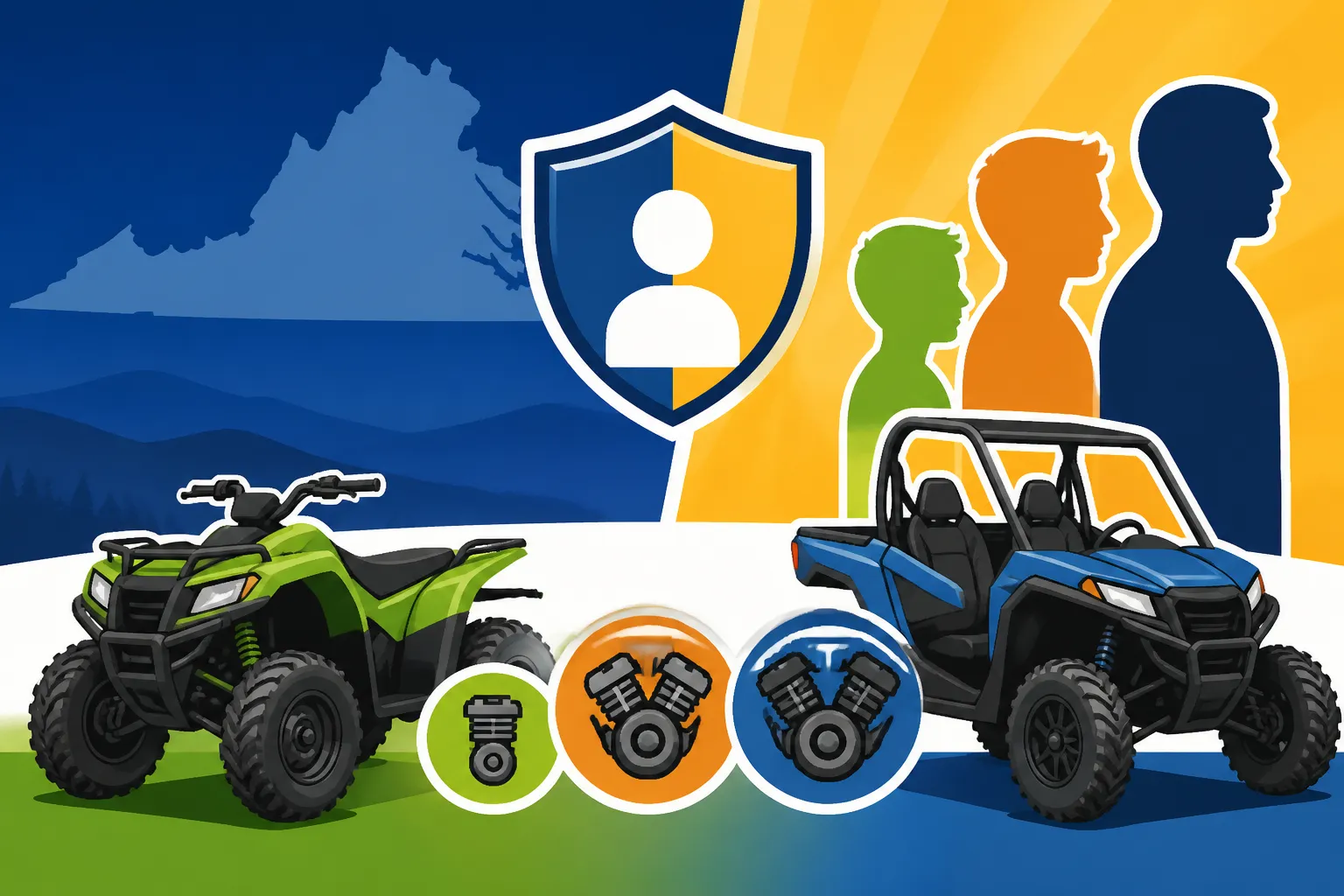
To help consolidate the information, here’s a quick overview of Virginia’s core age and engine size restrictions for ATVs:
| Age Group | Maximum ATV Engine Size | Notes & Key Considerations |
|---|---|---|
| Under 12 Years Old | 70cc (70 cubic centimeters) | This is a strict, absolute limit. No amount of skill or adult supervision allows for operation of an ATV over 70cc. |
| 12 to 16 Years Old | 90cc (90 cubic centimeters) | Allows for progression to slightly larger youth models. Still a hard limit; supervision does not change this. |
| 16 Years Old and Over | No Engine Size Limit | Riders 16+ can legally operate adult-sized ATVs. All other ATV laws (helmet, trespassing, no road use) still apply. |
Note: For UTVs/Side-by-Sides, while not always explicitly tied to CC limits for minors in Virginia law, manufacturer age recommendations (often 16+ for full-size models) should be strictly followed for safety and liability reasons.
Disclaimer
This article is for general informational purposes only and does not constitute professional advice. Laws, prices and regulations vary by location and change over time. Consult a qualified professional for guidance on your specific situation.