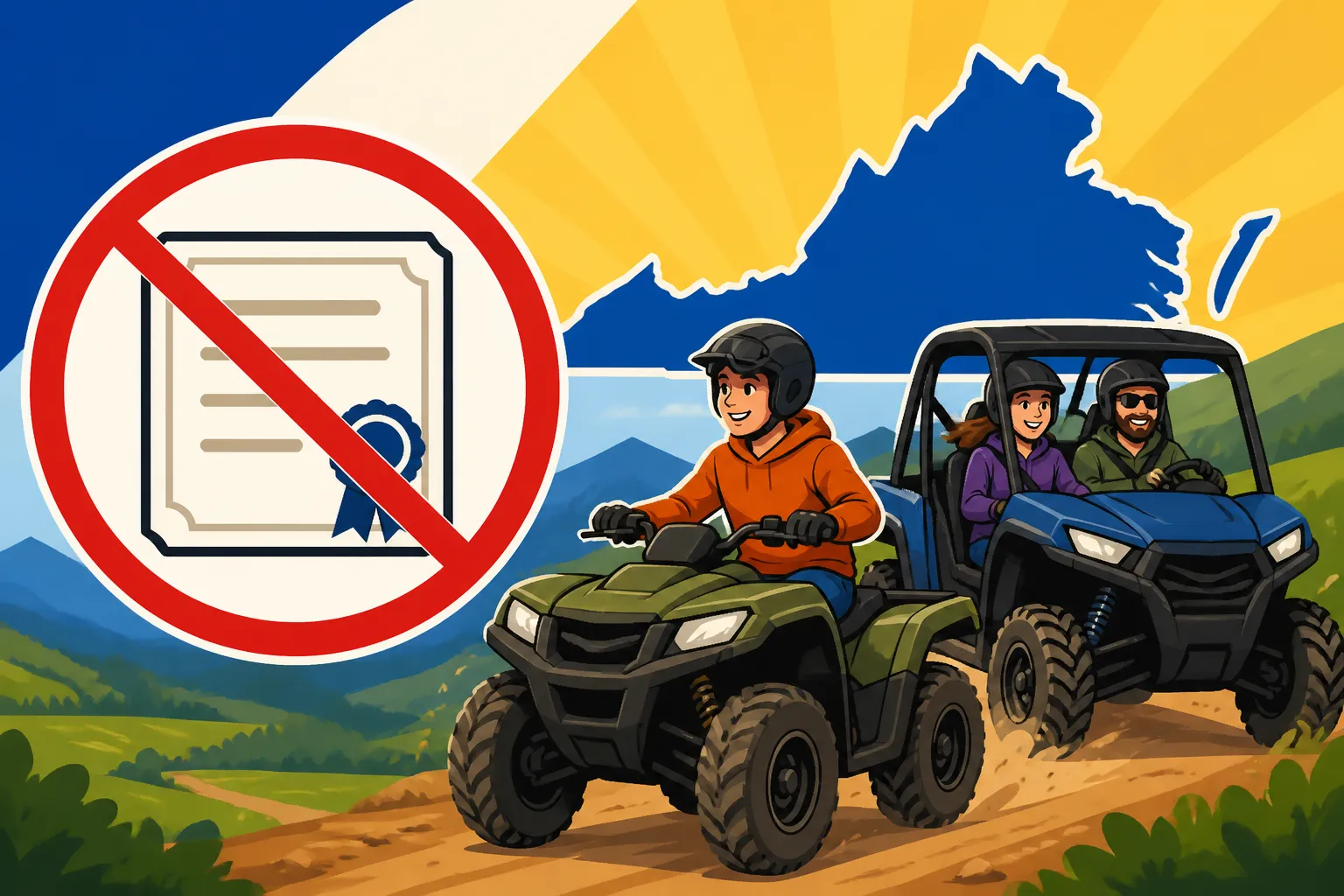
No Certificate Required at Any Age
Virginia riders often hear that a safety course is required, especially when planning a trail trip with a child or visiting from another state. In general, Virginia does not require an ATV safety-course certificate at any age. That does not remove age limits, permit rules, or trail-specific requirements, which still need checking before you ride.
What “No Certificate Required” Means in Virginia
Virginia does not generally make completing an ATV safety course a condition of riding an ATV or UTV. A rider is not required to show a state-issued course certificate simply because they are a certain age or because they are visiting a Virginia trail system. The distinction matters: a training certificate is not the same thing as a riding permit, driver’s license, proof of identity, or permission to use a particular property.
The phrase “at any age” also needs context. It means there is no general statewide safety-course certificate requirement tied to a rider’s age. It does not mean that a child of any age may ride any machine, or that adult riders are exempt from all other rules. Age and machine-size restrictions, helmet requirements, manufacturer recommendations, landowner consent, and trail-system rules may all affect whether a person can ride.
For a broader explanation of the course rule, see Virginia Has No Safety Course Requirement. The practical takeaway is straightforward: do not sign up for a course solely because you think Virginia law requires a certificate before you can ride. Instead, check the rules for the exact trail, park, land, and machine you plan to use.
A private riding park can set its own entry conditions. A park may ask riders to complete training, follow a particular orientation, meet an age minimum, or satisfy other conditions even when the state does not require a safety certificate. That is a property policy, not evidence of a general Virginia certificate mandate. If a website or booking form asks for proof of training, contact the operator and ask what it requires and which riders the condition applies to.
A certificate is not a permit
A course certificate shows that a rider completed a training program. A permit authorizes access to a specific riding area under that area’s rules. One does not automatically replace the other. Where a trail system requires a permit, completing a course does not by itself authorize a ride. Conversely, having a valid permit does not mean the rider has completed a course.
| Item | What it generally does | What it does not automatically do |
|---|---|---|
| Safety-course certificate | Documents completion of a course | Provide access to a trail system |
| Trail permit | Meets an access requirement for a particular system | Prove that a rider completed training |
| Driver’s license | May satisfy an operator-qualification rule where one applies | Serve as a safety-course certificate |
| Landowner permission | Allows access to private property within the permission given | Override public laws or trail rules |
| Parent or guardian supervision | May meet a rule that calls for an accompanying adult | Cancel a minimum age or machine requirement |
That separation is especially useful when planning a trip across state lines. A training certificate earned elsewhere does not necessarily transfer a permit, land-access right, or operator qualification. Likewise, a rider who has no certificate should not assume a permit will be waived. Confirm each requirement on its own.
What Trail Rules Can Require Instead
A lack of a statewide course-certificate requirement does not make Virginia’s riding areas rule-free. Trail systems can require permits, identity checks, equipment, or particular operator qualifications. Public and private land can also have different conditions. Check the rules for the actual place you plan to ride, rather than relying on a general statement about Virginia.
For example, permit systems may operate separately from safety training. Spearhead Trails and Virginia National Forest riding areas have their own access procedures and rules. A Spearhead permit does not cover a different network that sells or issues its own access authorization. The same principle applies to out-of-state systems: a permit from another state is not automatically valid in Virginia. See Virginia Has No Permit Reciprocity and Hatfield-McCoy and Spearhead Still Sell Separate Permits.
Permit conditions can also include practical steps such as purchasing before arrival, completing a waiver, or being able to show proof of authorization during a check. A certificate does not substitute for any of those steps. For details on a particular permit, check the system’s current official instructions before leaving home. If access is digital, save the confirmation or follow the operator’s directions for showing it, especially if you expect weak cell service.
Some riding areas have operator requirements that sound like training rules but are not course-certificate rules. Peters Mill Run, for example, has a driver’s-license requirement. A driver’s license and a safety-course certificate are different documents; do not assume one satisfies the other. Review Virginia Forest License Requirements if you are planning a Forest Service ride, and check the current land-manager rules for the route and vehicle you intend to use.
Private parks can set their own standards, too. One may require an orientation or proof of training, while another may not. Requirements can differ by vehicle type, age, event, or activity. Ask the park directly whether its policy applies to every rider or only to certain riders, and whether it accepts a course completed elsewhere. A general statement about state law cannot settle a private operator’s entry conditions.
Before you load the machine, confirm these separate questions:
- Does the riding area require a permit, reservation, or waiver?
- Does it require a driver’s license or another operator qualification?
- Does it set age or machine-size limits?
- Are there rules for helmets, eye protection, passenger seats, or other equipment?
- Does the operator require a course or orientation even though Virginia does not generally require a course certificate?
- Do you have the required documents and can you show them at the trailhead?
This short check helps avoid the common mistake of focusing on a course certificate while overlooking the actual access condition. See Virginia Trail Rules for Riders Under 18 for another example of why age-related rules need to be considered separately from training.
Children, Teen Riders, and Out-of-State Visitors
Parents should not interpret “no certificate required at any age” as permission for a child to ride a machine that is too large or otherwise unsuitable. Virginia’s age-related rules and a manufacturer’s minimum-age guidance are separate from any course requirement. Trail systems may also apply their own age conditions. Review Virginia Rules for a Rider Under 18 and the relevant trail operator’s requirements before choosing a machine or planning a family ride.
For a young rider, consider at least three different sources of rules:
- Virginia law: State requirements may address matters such as helmets, age, machine size, passengers, or where riding is allowed.
- The trail system: An operator may set access conditions, permit rules, or supervision requirements.
- The machine manufacturer: The manufacturer may identify an age range or minimum age for a particular machine.
Those categories can overlap, but they are not interchangeable. A child’s completed course does not override an age limit, and an adult’s presence does not necessarily make an otherwise prohibited ride permissible. Nor does the absence of a certificate requirement mean that an operator must admit a child. Confirm the machine and rider rules for the exact location.
If a trail system requires an adult to accompany a minor, check who counts as the accompanying adult and whether the adult must have their own permit. Do not assume that a parent’s permit covers a child, or that a grandparent or other adult automatically satisfies a supervision rule. The operator’s current terms are the best place to verify those details. Virginia Parent Riding With a Child can help clarify the supervision question.
Visitors from another state should make the same distinctions. A home-state course card may be useful proof of training, but it does not necessarily grant Virginia trail access or satisfy an operator’s separate rule. If a Virginia private park asks for a certificate, ask whether it accepts an out-of-state credential and whether the condition applies to the vehicle and riders in your group.
The reverse is true when a Virginia rider travels elsewhere. Virginia’s general lack of a course-certificate requirement does not exempt a visitor from another state’s laws or a riding area’s policies. Check the destination’s current rules before traveling. If you ride in multiple states, keep course records accessible if you have them, but do not treat them as substitutes for local permits or required licenses.
When a Course Is Still Worth Taking
A course may be optional under Virginia’s general rules and still be worthwhile. Training can help riders practice controls, braking, turns, hills, safe spacing, and hazard awareness before encountering rough terrain or riding in a group. That can be especially helpful for a new rider, a young person, or someone moving from a small machine to a larger ATV or UTV.
A course is most useful when it matches the rider and vehicle. A course designed for an ATV may not cover the specific handling, passenger, or restraint considerations of a side-by-side. Ask what the training includes, what kind of machine is used, and whether the instructor offers age-appropriate instruction. If a family is learning together, consider whether each rider needs separate practice rather than assuming one participant’s training covers everyone.
Training also does not replace sound judgment on the trail. A certificate cannot make a route appropriate for an inexperienced rider, change a machine’s limits, or guarantee safe conditions. Start with terrain and distances that fit the least experienced person in the group. Discuss hand signals, stopping points, what to do if riders get separated, and how to respond to a breakdown before the ride begins.
If you want to take a course, look for a provider that clearly explains the curriculum, equipment, age eligibility, and whether it issues a completion record. Do not assume that every course is an official state credential or that every riding area recognizes it. Virginia Safety Course Options is a useful next step for comparing ways to find training, while Taking an ATV Safety Course No Law Requires explains the difference between a legal obligation and a voluntary safety choice.
If you are shopping for protective equipment, including helmets or eye protection, compare fit and safety specifications rather than relying on a product listing alone. A retailer such as Amazon may offer a wide selection, but the rider still needs equipment that fits correctly and meets any applicable trail or legal standard. Buying gear does not replace instruction, and taking a course does not replace required protective equipment.
The simplest plan is to treat training as a safety decision and permits as an access decision. Virginia generally does not require an ATV safety-course certificate at any age, but a specific riding area may ask for training, and other rules still apply. Check the machine, rider, destination, and current access requirements separately before setting out.
Disclaimer
This article is for general informational purposes only and does not constitute professional advice. Laws, prices and regulations vary by location and change over time. Consult a qualified professional for guidance on your specific situation.