Virginia Forest License Requirements
Virginia forest riding rules can be confusing because “license” may mean a driver’s license, an off-highway vehicle permit, or both. For Peters Mill Run and Taskers Gap, the key is to check the requirements for your specific trail and machine before loading up. Here’s how to separate the paperwork, understand the driver-license issue, and avoid arriving without something you need.
What “forest license” means on Virginia OHV trails
There isn’t one document that covers every requirement for riding an off-highway vehicle on Virginia’s national forest trails. Riders may need to meet operator requirements, hold the correct forest OHV permit, and follow rules for the trail system and machine. A driver’s license and an OHV permit serve different purposes.
On Peters Mill Run, riders should expect a valid driver’s license to be required for the operator. Check the current rule with the relevant Forest Service office before your trip, especially if your group includes a younger rider, a visiting rider, or someone who has a learner’s permit rather than a full license. Do not assume that another state’s license, a permit from a different riding system, or an ID card satisfies the requirement.
A driver’s license is not the same as permission to use a trail. The forest OHV permit is a separate requirement for eligible machines using the designated routes. The permit does not replace an operator’s license where one is required, and having a license does not mean the machine is permitted to ride.
| Item | What it does | What to check |
|---|---|---|
| Driver’s license | Shows that the operator meets the applicable licensing requirement | Whether the trail requires a valid driver’s license and whether the operator’s document qualifies |
| Forest OHV permit | Allows use of the covered forest OHV route under its terms | Which trails and dates it covers, how it must be carried or displayed, and who needs one |
| Machine eligibility | Determines whether the vehicle may use a particular route | Width limits, vehicle type, registration or equipment requirements, and posted restrictions |
| State age and safety rules | Apply alongside local trail rules | Age limits, helmet and eye protection requirements, and any rules that apply to the rider |
Rules may differ between routes and vehicle types, so avoid treating “national forest” as a blanket permission. Virginia National Forest OHV Permits covers the permit side, while Peters Mill Run Requires a Valid Driver’s License focuses on the operator-license question for that riding area.
A practical approach is to confirm requirements for the specific route you intend to ride, not just the forest name. Peters Mill Run and Taskers Gap are part of the same general riding area, but trail access and vehicle restrictions can vary within a system. Consult current Forest Service information and posted signs for the route you plan to use.
The permit is separate from your driver’s license
A national forest OHV permit is generally tied to authorized off-highway riding, not to your qualification as a driver. Riders should confirm whether their machine needs a permit, which permit period fits the visit, and whether the chosen permit covers the route. Rules and purchase options can change, so check current details through Virginia Forest Permit Purchase Options before leaving home.
Do not assume that a permit from one Virginia trail network works on a national forest trail. Forest OHV permits and Spearhead trail permits are separate systems; buying one does not automatically cover the other. Likewise, a pass, registration, or permit from a neighboring state should not be treated as a substitute unless the administering agency explicitly says it is accepted. Virginia has no general permit reciprocity that lets riders use one system’s permit everywhere.
The permit instructions also matter. Follow the current directions for carrying or displaying it, and keep any confirmation or documentation accessible if the permit is issued electronically or mailed to you. A screenshot can be useful for your records, but do not assume it replaces a physical permit or required display unless the current instructions say so.
Buy and verify before the drive
Some forest riding areas do not have a permit kiosk at the trailhead. If you arrive without a required permit, you may have to turn around or delay the ride. Check where permits are sold, whether mail orders take time, and whether the seller is open when you expect to arrive. No Kiosk at the Trailhead: Buy the Permit First and Virginia Forest Permit Mail Orders can help you plan the purchase.
Before paying, verify:
- The permit is for the forest riding area you intend to use.
- Its dates cover your trip.
- Your machine type is eligible for the route.
- You understand how the permit must be carried or displayed.
- Each rider or vehicle has whatever documentation the current rules require.
- You know what to do if the permit is lost, damaged, or not available offline.
Avoid relying on an old receipt, a photo of someone else’s permit, or a permit purchased for a different machine or riding network. If the purchase instructions are unclear, ask the selling office or the ranger district before traveling.
Who may ride and what to check for your machine
The driver-license requirement is only one part of deciding whether someone can operate a machine on a forest trail. State rules, trail conditions, machine limits, and age restrictions may also apply. A younger rider may be subject to restrictions based on age and engine size, even if an adult is present. A parent or accompanying adult should check the specific rules instead of assuming that supervision alone makes a rider eligible.
The machine itself needs to fit the route. Some forest trails impose width or equipment restrictions, and some routes allow vehicle types that others do not. For example, Taskers Gap has a width limit; do not assume a side-by-side or modified ATV will fit simply because it is an off-highway vehicle. Check Virginia Forest Equipment Requirements and the current information for your selected trail before hauling a wide or unusually equipped machine.
The vehicle should also be in safe operating condition. Requirements may address brakes, lights, a muffler, a spark arrester, tires, or other equipment. Do not rely on a machine’s factory setup without checking whether it meets the current trail rules. If your vehicle has been modified, ask whether the changes affect eligibility or compliance.
For younger operators, verify both the machine’s manufacturer age recommendation and the applicable Virginia requirements. These are not necessarily the same thing. A machine marketed for a certain age group does not override a legal restriction, while meeting a legal limit does not guarantee that a child can safely control a particular vehicle. The adult planning the trip should consider the rider’s size, skill, protective gear, and the terrain as well as the paperwork.
A quick comparison helps keep the requirements straight:
| Rider or vehicle question | Why it matters | Useful next step |
|---|---|---|
| Does the operator hold a qualifying driver’s license? | A license may be required on a particular forest route | Confirm the trail’s current rule before traveling |
| Is the operator old enough for the machine? | Age limits and engine-size restrictions may apply | Check Virginia rules and manufacturer guidance |
| Does the machine fit the route? | Width and vehicle-type limits can exclude some machines | Measure the vehicle as equipped and check route restrictions |
| Is the required permit valid? | The permit may be limited by area, date, or machine | Read the purchase terms and bring it as instructed |
| Is the machine properly equipped? | Forest rules may require specific safety or emissions-control equipment | Review current equipment rules and inspect the machine |
Keep the paperwork question separate from the safety question. A rider who meets the license requirement still needs to operate within their ability, use appropriate protective equipment, and follow the trail’s rules. For related guidance on equipment, permits, and closures, see Virginia Forest License Requirements, Virginia Forest Noise Limits, and Virginia Forest Season Closures. The first title in that list is the current topic, so do not treat it as a separate resource; the latter two address additional checks that can affect a trip.
A pre-trip checklist for forest riding
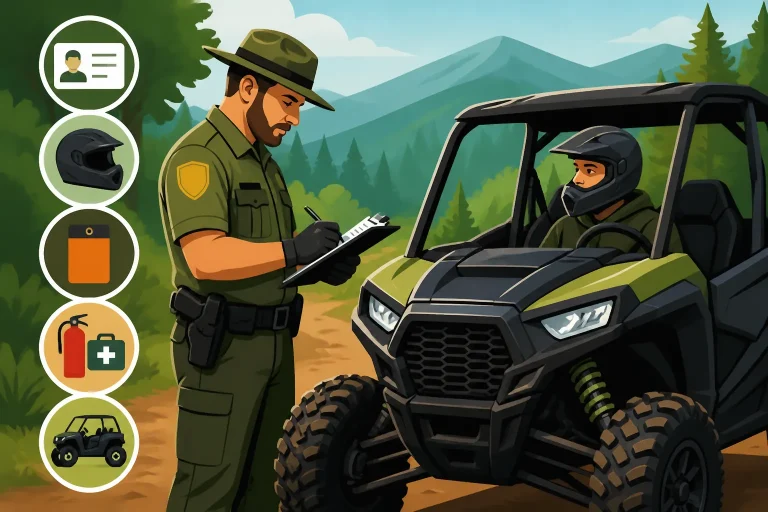
A few calls and checks before departure can prevent a long drive to a trailhead you cannot legally or safely use. Start with the operator: confirm whether the selected route requires a valid driver’s license and whether each person who plans to drive meets that requirement. If anyone has a learner’s permit, an out-of-state document, or no driver’s license, ask the relevant Forest Service office directly rather than guessing.
Next, check the permit. Confirm the correct permit type, dates, covered area, purchase method, and instructions for carrying or displaying it. Do not rely on a permit from Spearhead, Hatfield-McCoy, or another riding area as a substitute for the national forest permit. Virginia Forest Permit Cost can help you identify the cost-related questions to verify, but check the provider for current figures and terms.
Then check the machine. Confirm that its width and vehicle type are allowed on the intended route. Look over the equipment requirements, including any applicable requirements for brakes, lights, a muffler, or a spark arrester. If your vehicle is altered, unusually wide, or built for a different kind of riding, ask before you haul it.
Finally, check conditions and access. A trail can be closed because of seasonal schedules, weather, maintenance, or other restrictions. Use current Forest Service information rather than an old map, an outdated forum post, or a previous visit as proof that a route is open. Find out whether your trailer can be parked safely at the trailhead and whether you will have a way to show your permit if mobile service is unavailable.
For a group, designate one person to verify the rules and share the details with every operator. Each person should know which routes are open, who has the permit information, and what to do if a rider or machine does not meet the requirements. A quick pre-ride check can include:
- Confirm the planned route is open and allows your machine type.
- Verify driver-license requirements for every operator.
- Check age, engine-size, and protective-equipment rules for younger riders.
- Buy the correct forest OHV permit and follow its carrying or display instructions.
- Inspect the machine against current equipment and width requirements.
- Save the relevant rules and permit details where you can access them without cell service.
- Recheck closures and conditions shortly before departure.
If a requirement is unclear, contact the ranger district or the permit seller and describe the exact route, vehicle, and operator situation. “We’re riding in the national forest” may not give them enough information to answer. Ask specifically whether a full driver’s license is required, whether a learner’s permit qualifies, which permit covers the trail, and whether your machine is within the route’s limits.
Common mistakes to avoid
The most common paperwork mistake is confusing a driver’s license with a trail permit. Both may matter, and neither automatically substitutes for the other. Another is assuming that a permit from a different network will be accepted. Treat every permit as system-specific unless the administering agency confirms otherwise.
Riders can also get caught out by relying on past experience. Requirements, closures, permit sales arrangements, and trail access may change. A route that was open on your last trip may have a different restriction now. Confirm current information before setting out, especially for a long-distance visit or a group ride.
Do not assume that a valid driver’s license makes every machine or operator eligible. Width, vehicle class, age restrictions, equipment condition, and seasonal access still matter. Conversely, do not assume that a person without a driver’s license can ride because the vehicle is off-road. If the route requires one, get a direct answer from the forest office before planning around an exception.
Keep the answers you receive with your trip notes. Record the office you contacted, the trail you asked about, and the specific facts you provided. This is particularly useful when your question involves a young rider, a learner’s permit, or a machine near a width limit. If signs at the trailhead conflict with older information, follow the posted restriction and contact the managing office for clarification.
The simplest rule is to verify three separate things: the operator’s license eligibility, the correct forest permit, and the machine’s permission to use the chosen route. Checking all three before departure is more reliable than treating “forest license” as a single document.
Disclaimer
This article is for general informational purposes only and does not constitute professional advice. Laws, prices and regulations vary by location and change over time. Consult a qualified professional for guidance on your specific situation.