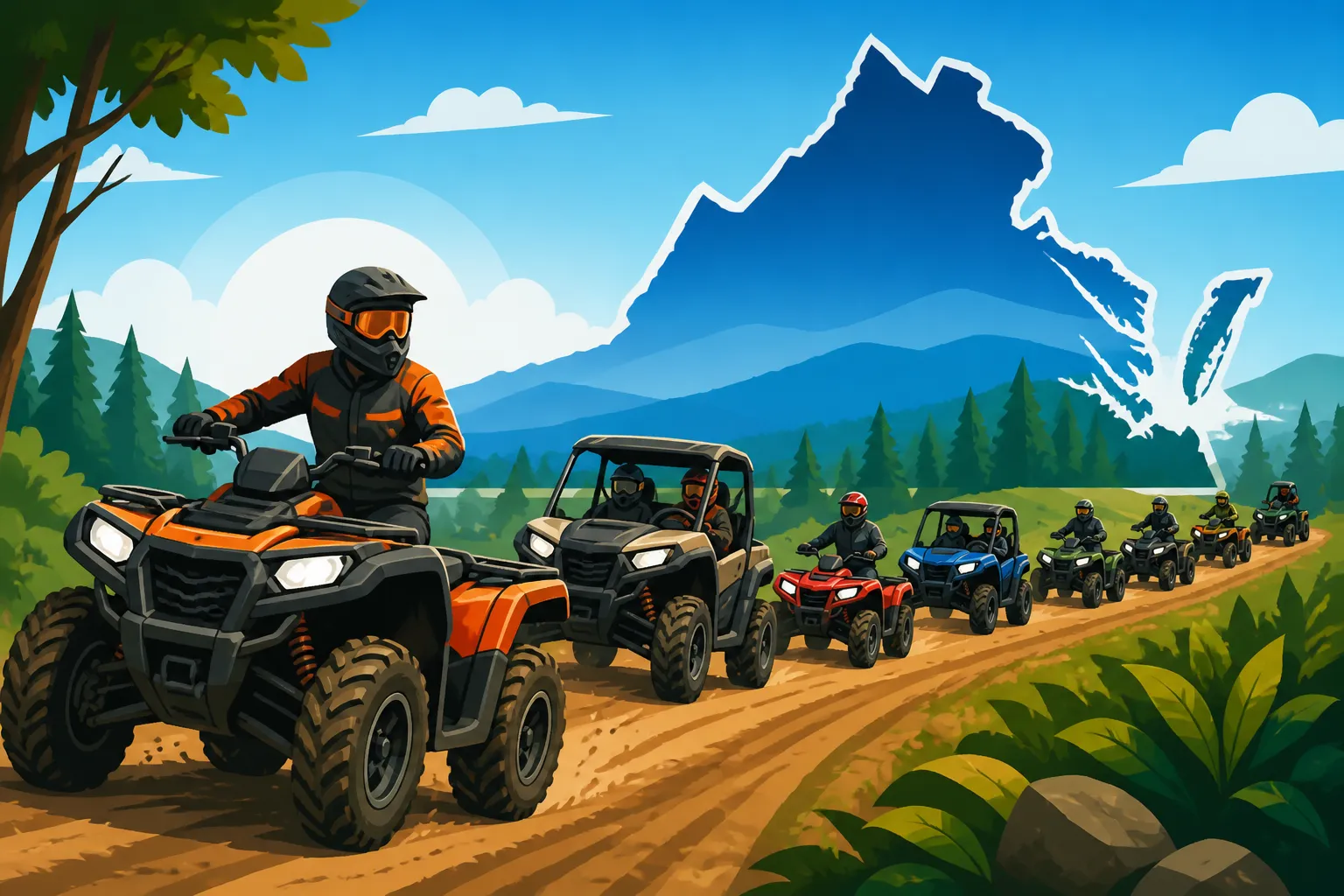
Virginia Riding With a Group of Ten
A group of ten can turn a Virginia trail day into a great shared adventure—or a long string of missed turns, delayed riders, and confused vehicles. The key is to plan around the specific trail system, machine types, permits, and the slowest rider in your group. This guide explains how to organize ten riders, keep everyone together, and avoid preventable trail-day headaches.
Start with the trail system, not the group size
Check whether ten riders fit the area’s rules
Virginia does not have one universal group-size rule that automatically applies to every trail, private riding park, or managed off-highway network. Rules can differ by property and operator, and may change by trail, event, season, or type of machine. A group of ten may be welcome in one place and need to split up or make arrangements in another.
Before inviting everyone, check the rules for the exact riding area. Look for requirements about group size, reservations, guided rides, permits, age limits, vehicle width, passenger seating, and operating hours. If the rules are unclear, contact the trail office or property manager directly. Ask whether ten machines may ride together, whether the group needs to register in advance, and whether any routes have separate restrictions.
Do this before people haul machines from Roanoke, Richmond, or beyond. A quick call can prevent the especially frustrating situation where the group arrives together but learns at the entrance that its plan does not meet the property’s requirements. For general questions to raise, see [Virginia Group Size on a Trail System] and [Questions Worth Asking a Spearhead Trail Office].
Match the route to the machines and riders
A group of ten is rarely made up of ten identical machines and ten riders with the same experience. You might have several ATVs, a two-seat side-by-side, a newer rider, and someone who has spent years riding Appalachian trails. That mix matters. A trail’s width, surface, steepness, and turning room can make a route suitable for one machine but awkward or inappropriate for another.
Check what the area allows before settling on a route. In particular, verify whether side-by-sides are permitted on the system and whether there are width limits or route-specific restrictions. Do not assume that a trail open to ATVs is automatically suitable for every UTV. The distinctions covered in [Virginia Trails That Allow Side-by-Sides] can help you think through the question, but the riding area’s own rules should guide your final plan.
Then compare the trail’s difficulty with the least experienced person in the group—not with the most confident rider. A steep, rocky climb that feels entertaining to an experienced rider can become a stressful bottleneck for a beginner, especially if several machines are waiting behind them. Use the system’s ratings and descriptions as a starting point, and plan an easier alternative if the group’s abilities vary. [Virginia Trail Difficulty Ratings] is a useful related read when deciding how ambitious the route should be.
| Planning question | Why it matters for ten riders | What to check |
|---|---|---|
| Is a group of ten permitted? | A large group may need advance approval or may have to split up. | Trail-system rules, event requirements, or the office |
| Are all machine types allowed? | ATVs and UTVs may face different access or width rules. | Vehicle definitions, width limits, and route signs |
| Does the route fit the least experienced rider? | A difficult section can hold up the whole group. | Trail ratings, terrain descriptions, and an easier alternative |
| Are permits or reservations required? | A missing permit can disrupt the day before riding starts. | The operator’s current permit and reservation instructions |
| Are there closures or seasonal limits? | A planned route may be unavailable on arrival. | Official closure notices and operating information |
Organize the group before you reach the trailhead
Choose a lead rider and a sweep rider
A ten-machine group should not rely on everyone simply following the person at the front. Name a lead rider who knows the planned route and is willing to set a pace the entire group can manage. Also choose a sweep rider—the person who stays behind the last machine and checks that no one gets left behind.
The lead rider should not treat every turn as obvious. At junctions, stop in a safe, visible place and make sure the next person knows which way the group is going. The sweep rider can confirm that the last machine has made the turn before the lead rider moves on. That simple habit helps prevent a common group-ride problem: the front riders keep going, the back riders take a different branch, and nobody realizes the group has split until later.
Give everyone the lead and sweep riders’ names before setting out. Agree on what to do if someone has a mechanical problem or needs to stop. A sensible plan might be for the person with the issue to pull off in a safe spot with a buddy, while the lead and sweep riders regroup the rest of the group rather than leaving one rider alone.
Set a pace, a meeting plan, and communication signals
A group ride works better when expectations are clear before engines start. Tell everyone the approximate route, the planned stops, and whether the day is intended to be leisurely or challenging. For a mixed-experience group, agree that the pace will be set by the riders who need the most time, not by whoever reaches each junction first.
Cell reception can be unreliable in mountain and wooded areas. Do not make a phone call the only plan for reconnecting. Pick recognizable meeting points—such as the trailhead or a clearly identified junction—and agree that nobody will take an unplanned route without notifying the group. If your group uses radios, test them before leaving the staging area and choose a simple channel and call-sign system. Keep instructions short and repeat important information, especially when engine noise makes conversation difficult.
A map is useful even when someone in the group knows the area. Tools such as onX Offroad can help riders review routes and identify junctions before the trip; download or save the information you expect to need before you enter an area with weak reception. Have at least one backup map or route reference available, and make sure more than one person knows how to interpret it. For broader route-planning habits, see [Virginia Group Ride Planning].
Keep ten riders safe and moving on the trail
Ride in a way that gives everyone room
A tightly packed line can feel organized, but it leaves little room to react when the rider ahead slows, stops, or hits an unexpected obstacle. Leave enough space to see the trail and respond without crowding the next machine. Avoid riding side by side where the route is narrow, visibility is limited, or the terrain makes it difficult to maneuver.
At a blind corner or crest, slow down and stay predictable. Dust, loose rock, wet leaves, and changing light can reduce visibility. If a rider stops, signal the machines behind rather than blocking the route without warning. When the trail is wide enough for a safe pull-off, move out of the way before gathering the group. A line of ten machines stopped in a blind section can create a hazard for both your own riders and anyone else using the route.
Make sure passengers are only carried where the machine is designed and equipped for them, and that each rider follows the site’s safety requirements. The group’s preparation should include appropriate protective gear, water, and a basic first-aid plan. For site-specific expectations, review [Virginia Trail Etiquette Locals Expect] and [Virginia Rules for a Side-by-Side Driver].
Build a realistic schedule with room for delays
Ten machines take longer to line up, fuel, unload, check permits, and get moving than a small pair of riders. They also take longer to pass through narrow sections and regroup after stops. Plan a shorter first loop than you might attempt with two or three experienced riders. If the group is running smoothly, you can decide whether to add distance later.
Allow time for breaks and basic checks. A rider who needs to adjust a helmet, check a tire, or hydrate should not feel pressured to keep moving just because the group is behind schedule. Before leaving the staging area, check that each machine has enough fuel for the intended ride and that essential equipment is in working order. Agree on a turnaround time so the group does not end up rushing back near closing time.
Be flexible when conditions change. Heavy rain, muddy sections, fallen branches, or an unexpectedly difficult climb can slow a ten-machine group considerably. If a route is no longer a good fit, turn around or choose an easier option rather than pushing on because it was written into the plan. [Virginia Trail Conditions Before You Haul] and [Virginia Trail Closures and Seasons] are useful reminders to check access and conditions before making a long drive.
Make a practical plan for the day
Confirm permits, access, and staging details
Do not assume that a permit or reservation for one riding area works at another. Different trail systems may have separate access rules, payment processes, or requirements for the person operating each machine. Check the official instructions for the specific destination and make sure every member of the group knows what they need to bring or complete before arriving.
Ask about the details that affect a large group: whether there is enough trailer parking, where machines may be unloaded, whether the staging area has space for ten vehicles, and whether there are restrictions on gathering or parking. If the trail operator asks groups to check in or provides a preferred arrival window, follow that process. A convoy arriving all at once can create congestion even when the group has done everything else correctly.
Keep the permit or reservation information accessible to the people responsible for checking in. If digital confirmation is involved, save the relevant details before you leave home rather than relying on a strong signal at the gate. A route-planning app such as onX Offroad can be useful for keeping a shared idea of the planned route, but it does not replace the trail operator’s current access rules or official directions.
Use a final checklist and a backup plan
The evening before the ride, send one clear message with the meeting location, arrival time, route plan, lead and sweep riders, and what each person should bring. Ask riders to reply if their machine or experience level differs from what the group expects. This is also the time to identify anyone who needs a simpler route or a passenger seat, rather than discovering the mismatch at a difficult trail junction.
Before departure, confirm that the group has checked the riding area’s rules, permits, closures, machine restrictions, and parking arrangements. Review the route together and identify at least one place where the group can regroup. If the planned area is closed or unsuitable, have a second destination or a shorter ride ready. A backup plan does not need to be elaborate; it simply gives the group a calm alternative instead of turning a disappointing update into a rushed decision.
For planning and rule checks, spread responsibilities across the group. One person can confirm access and permits, another can review the route and closures, and another can coordinate the meeting point and trailer parking. That is often more reliable than expecting one organizer to remember every detail for ten riders. A final review of [Virginia Permit Questions Riders Ask] can help you spot practical permit questions before the group sets off.
Disclaimer
This article is for general informational purposes only and does not constitute professional advice. Laws, prices and regulations vary by location and change over time. Consult a qualified professional for guidance on your specific situation.