Virginia Trails Near Winchester
If you’re based in Winchester, the frustrating part of finding an ATV or UTV ride is that nearby-looking forest roads aren’t automatically open to off-highway vehicles. The clearest public-land option is south of town near Edinburg: Peters Mill Run and Taskers Gap in the George Washington National Forest. This guide explains what to expect, how to plan, and what to check before hauling your machine.
The main public riding option near Winchester
Peters Mill Run and Taskers Gap
Peters Mill Run and Taskers Gap are the main public-land OHV riding areas to investigate when you’re starting from Winchester. They sit in the George Washington National Forest near Edinburg, south of town along the Shenandoah Valley. The area offers a more natural forest-road experience than a purpose-built private park, with routes through wooded mountain terrain and changing surfaces.
The two areas are often discussed together, but their access rules and trail characteristics are not interchangeable. Peters Mill Run is generally the more accommodating choice for wider machines, while Taskers Gap has a width restriction on its routes. Before you plan a day around a particular loop, read [Virginia's 36-Mile Peters Mill Run and Taskers Gap System] and [Virginia's Taskers Gap Width Limit]. Those details can help you avoid the unpleasant surprise of reaching a trail entrance with a machine that does not fit the requirements.
The route names and total mileage can make the area sound like one continuous ride, but access depends on the specific route, its current status, and your vehicle. A trail shown on a consumer map is not proof that it is open to your ATV or UTV. Use official forest information to confirm which routes are designated for motorized use, then compare that information with your machine’s dimensions and capabilities.
Picking the right route for your machine
For a wide side-by-side, check the width restrictions before you load the trailer. Taskers Gap’s limit is a practical dividing line: if your vehicle exceeds it, do not assume you can simply choose a different loop after arriving. Peters Mill Run may be the better fit for some wider machines, but that still does not mean every route in the larger area is suitable or open to every vehicle.
A measuring tape is more useful than a guess. Measure the machine at its widest point, including accessories such as mirrors, wheel spacers, or aftermarket tires if they affect the overall width. If the manufacturer lists a width that is close to the posted limit, confirm how the trail manager measures eligibility rather than relying on a rounded number in a sales listing.
Terrain matters just as much as dimensions. A stock utility ATV may handle a different line comfortably than a long, heavy UTV with a full load of passengers and gear. Think about ground clearance, tire condition, turning room, and the experience of the least-confident rider in your group. [Why Peters Mill Run Has No Width Limit] can help explain why the two nearby areas should not be treated as if they have identical access rules.
Permits, closures, and rules to check
Get the forest permit sorted out before the drive
Riding in a national forest is not the same as taking a machine onto an ordinary public road. A forest OHV permit may be required, and the applicable permit depends on the riding area and the length of your visit. Check the official forest information before leaving Winchester, especially if you are planning a weekend trip or bringing visitors who may assume that a permit from another riding network will work here.
Do not wait until you reach the trailhead to figure out how to buy one. Some trailheads may not have a kiosk or reliable cell service, so planning ahead can save a frustrating detour. For the practical details, see [Virginia National Forest OHV Permits] and [No Kiosk at the Trailhead: Buy the Permit First]. Confirm whether permits are available online, from a ranger district office, or through an authorized vendor, and make sure you understand what proof you need to carry.
Permit rules are only one part of your pre-ride checklist. Forest routes can have equipment standards, noise limits, and restrictions on tire types. Check the current requirements for items such as a spark arrester, working brakes, a muffler, and lights. If you are riding a group of machines, share the rules with everyone before the trip. One rider arriving without the necessary permit or equipment can hold up the whole group.
Plan around seasonal and weather-related closures
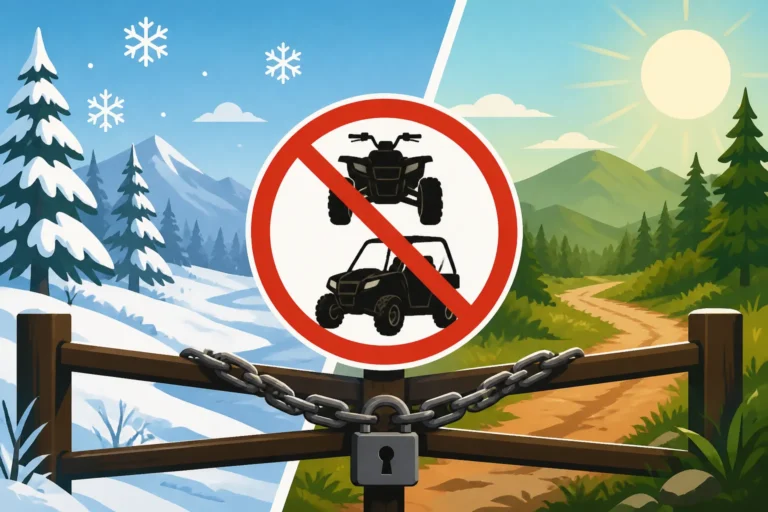
Forest riding can be seasonal. Routes may close during winter, and additional closures can happen when conditions are unsafe or the surface needs protection. The timing can vary, so do not rely on a forum post or a map screenshot saved from a previous season. Check for the latest closure notices before you hitch up, especially after snow, heavy rain, or a long stretch of wet weather.
The trip can feel like a waste if you discover a closure only after reaching the area. A quick check of [Virginia Forest Season Closures] and [Virginia Trail Conditions Before You Haul] is a sensible part of planning, not busywork. If the forest office lists a closure, do not treat an alternate entrance or nearby road as a workaround. A closed route is closed even if a navigation app still displays it.
Weather also affects the ride even when the trail is technically open. Rain can make rocky or rutted sections more difficult, while fog and falling temperatures can change visibility and comfort quickly in the mountains. Check the forecast for the riding area rather than relying only on conditions in Winchester. Pack layers, water, basic tools, and a way to contact help if your phone loses service.
| Planning question | Why it matters | What to confirm before leaving |
|---|---|---|
| Is the route open? | Seasonal or weather closures can change your plan. | Current forest notices and trail status |
| Does your machine fit? | Some routes have width restrictions. | Your vehicle’s measured width and route limits |
| Do you need a permit? | Forest OHV access may require a specific permit. | Permit type, purchase method, and proof to carry |
| Is your machine equipped properly? | Equipment and noise rules can apply. | Current forest requirements for your machine |
| Will your group be comfortable? | Skill, weather, and terrain affect the day. | Route difficulty, forecast, supplies, and backup plan |
Planning a ride from Winchester
Use maps to plan, but verify access
A mapping app can help you understand how routes connect, estimate where you will be riding, and keep track of your position when cell service drops. onX Offroad can be useful for organizing a trip and reviewing map layers before you leave. Download the information you need ahead of time if you expect to ride beyond reliable cell coverage.
Still, a line on a digital map is not an access authorization. A route may be closed, restricted to a different kind of vehicle, or shown in a way that does not make its legal status clear. Compare your navigation plan with official forest maps and notices. Treat any mismatch as a reason to pause and verify, not as permission to proceed.
A good routine is to mark your intended trailhead, confirm the permitted routes, and save a backup plan before the drive. Tell another person where you expect to ride and when you plan to return. Keep a paper map or written directions as a backup. These steps are especially helpful when a group splits up, a phone battery runs low, or the route takes longer than expected.
onX Offroad can also help you keep your group oriented, but make sure everyone knows how to use the map before the ride begins. If one person is leading, agree on what the group will do if riders become separated. Decide on a meeting point and a simple rule for stopping at forks; a few minutes of planning can prevent a small navigation mistake from turning into an anxious search.
Prepare for the drive and the trail day
From Winchester, the riding area near Edinburg is close enough to make a day trip realistic for many riders, but it is still worth treating the outing like a mountain excursion. Check your trailer lights, tie-downs, tires, and load before departure. Bring enough fuel for the ride and the return to a reliable station, and do not assume you will find fuel immediately beside the trail.
The route itself may be rougher or slower than a casual forest drive. Pack a basic tool kit, tire repair supplies suited to your machine, drinking water, food, and weather protection. UTV riders should check seatbelts and any required safety equipment, while ATV riders should wear protective gear appropriate to the terrain. Keep your machine’s registration or ownership documents accessible if you need to identify it or answer questions during your trip.
When you arrive, take a moment to read posted signs and confirm you are at the correct access point. Follow marked routes, keep your speed appropriate to visibility and surface conditions, and give other users room. Avoid spinning tires or creating unnecessary ruts, particularly when the trail is soft. [Virginia Trail Etiquette Locals Expect] offers useful reminders for sharing a popular riding area respectfully.
Making the most of nearby riding
Peters Mill Run and Taskers Gap are a strong starting point for Winchester-area riders who want a public forest setting, but they are not a reason to assume every nearby gravel road is open to ATVs or UTVs. Plan around designated routes, machine restrictions, permits, and closures. If your vehicle does not meet a route’s limits, choose an appropriate alternative rather than trying to squeeze through.
For a first visit, keep the day simple: confirm access, pick a route that suits the least experienced rider, leave enough time to return before conditions change, and avoid overloading the schedule. A conservative first ride gives you a better feel for the surface, signage, and travel time. Once you know the area, you can plan a longer outing with more confidence.
If the forecast turns poor, the permit information is unclear, or you cannot confirm that your intended route is open, postpone the ride. That can be disappointing after loading the trailer, but it is better than arriving at a closed trailhead or risking damage to a machine and the forest. A little checking before leaving Winchester makes the ride more predictable—and a lot more enjoyable.
Disclaimer
This article is for general informational purposes only and does not constitute professional advice. Laws, prices and regulations vary by location and change over time. Consult a qualified professional for guidance on your specific situation.