Virginia Trails for Kids
A family ride can turn stressful fast when the trail is rougher than expected, a child’s machine is too large for their age, or the riding area has rules you didn’t know to check. This guide explains where Virginia families can ride, how to match a route to a child’s experience, and what to confirm before loading the trailer.
Where families can ride in Virginia
Virginia’s family riding options include managed trail systems, national forest routes, and private off-road parks. They are not interchangeable: each can have different terrain, vehicle limits, permits, age rules, and operating schedules. A little checking before you leave can save a long drive with a disappointed young rider.
Start with managed trail systems
Spearhead Trails in Southwest Virginia is a major place to begin researching organized off-road riding. Its systems include trails around communities such as Grundy, Coeburn, Richlands, and Haysi. The network offers different types of terrain, so a family can look for a less challenging route rather than assuming every trail is suitable for a child’s first ride. For an overview, see [Virginia ATV Trails: Spearhead and the Forest] and [Best Virginia ATV Trails for Beginners].
A system’s beginner designation is a useful starting point, not a promise that every section will feel easy. A route that seems manageable on a map can still have steep grades, loose rock, ruts, narrow turns, or changing conditions after rain. Before setting out, check the trail system’s rules and current route information, and ask about the character of a specific trail if you are unsure.
Managed systems may also have their own permit and supervision requirements. Check the rules for every rider in your group, including children, rather than assuming that an adult’s permit covers everyone. [Virginia Youth Permit Rules] and [Virginia Permit Checks on the Trail] are useful topics to review before you go.
Consider national forest routes carefully
Peters Mill Run and Taskers Gap, near Edinburg in the George Washington National Forest, offer a different experience from a managed trail network. Forest routes can appeal to families who want a quieter day out, but they may be rocky, uneven, or more remote than a child expects. They are not automatically the best choice for a new rider just because they appear on a map.
Check the Forest Service’s requirements before traveling, including permits, vehicle rules, equipment standards, and seasonal closures. Peters Mill Run has a winter closure, and trail access can also be affected by conditions outside the regular shutdown. For planning details, review [Virginia National Forest OHV Permits], [Virginia Trail Conditions Before You Haul], and [Virginia Trail Closures and Seasons].
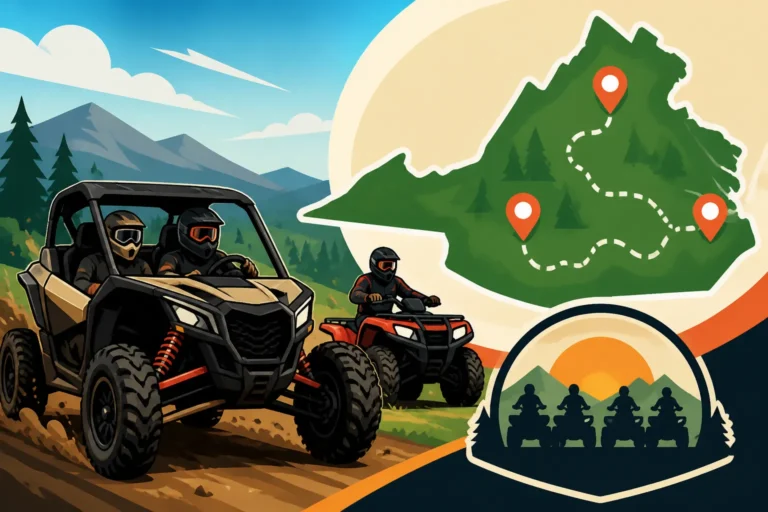
A map can help you understand the general route and nearby access points, but it cannot tell you everything about a trail’s present condition or whether a route is appropriate for your child. Tools such as onX Offroad can help families study routes and prepare offline maps before heading into areas with weak cell service. Treat any map as a planning aid, then confirm access and closures with the land manager.
Don’t assume a state park is an ATV trail
Virginia state parks generally are not places to take an ATV or UTV for trail riding. Before planning a trip around a state park, check its rules rather than assuming that public land is open to off-road machines. [Virginia State Parks Ban ATVs] covers this distinction.
Private off-road parks may be another option, but their rules can vary considerably. One park may set a minimum age or require a child to ride with an adult; another may have separate rules for machine size, helmets, passengers, waivers, or permitted riding areas. Call or check the park’s own information before you book or drive there.
| Riding option | What families may like | What to check before leaving |
|---|---|---|
| Spearhead trail systems | Managed routes and a range of riding experiences | Permits, age and supervision rules, route difficulty, and current access |
| Peters Mill Run and Taskers Gap | National forest riding near Edinburg | Forest permit, machine and equipment requirements, closures, and terrain |
| Private off-road park | Park-specific facilities and rules | Minimum age, machine limits, supervision, helmets, fees, and availability |
| Virginia state park | Outdoor activities for the whole family | Confirm whether off-road machines are allowed; do not assume ATV trail access |
Choose a route and machine that fit the child
A child’s age is only one part of the decision. A route should match their ability to control the machine, respond to changing ground, and stay calm when an adult asks them to stop or slow down. It is completely reasonable to choose a shorter, easier ride even if a child is eager to tackle more.
Follow Virginia’s age and engine-size rules
Virginia law sets engine-size limits for younger ATV riders: children under 12 are limited to machines of 70cc or less, and riders from 12 until 16 are limited to machines of 90cc or less. Riders 16 and older are not subject to those same age-based engine-size caps, but that does not mean every machine is a sensible fit for every teen. Review [Virginia ATV Age Requirements], [Virginia Rules for a 10-Year-Old Rider], and [Virginia Rules for a 13-Year-Old Rider] when checking how the rules apply to a particular child.
A machine that meets the legal engine-size limit can still be too heavy, tall, or powerful for a young rider to manage safely. Read the manufacturer’s age and size guidance, and consider whether the child can comfortably reach and use the controls. They should be able to stop smoothly, steer without struggling, and handle the machine’s weight if it begins to tip.
There is no need to make a child’s first outing a test of confidence. Let them practice starts, stops, and turns in a controlled area before attempting a trail. If they are tense, tired, or overwhelmed, a break—or calling it a day—is a better choice than pressuring them to continue.
Match the route to experience, not enthusiasm
A child who rides confidently in a flat field may still find mountain terrain intimidating. On an unfamiliar trail, start with short, gentle sections and let the child get used to the surface and pace. Stop somewhere safe to check how they feel before going farther.
Look beyond color ratings or broad labels such as “easy.” Ask whether the route has steep climbs, sharp drop-offs, loose gravel, water crossings, tight turns, or narrow sections. If a trail branches into harder routes, agree in advance that the group will stay together and take the easier option whenever there is doubt. [Virginia Trail Difficulty Ratings] can help you think through how trail difficulty is described.
Use a map to plan a route with clear turnaround points rather than promising a full loop before you know how the child is doing. onX Offroad can be useful for reviewing route layouts and saving maps before you lose reception, especially when the family is unfamiliar with the area. Still, a digital route line does not tell you whether a child will enjoy a steep, rocky stretch. Check local conditions and be ready to change the plan.
Treat UTVs differently from youth ATVs
A UTV is not simply a larger ATV. It has different handling, seating, and safety equipment, and trail systems may impose specific rules for vehicle width, roll cages, and seatbelts. Before taking a child in a UTV, confirm that the system allows that machine and that each passenger has a proper seat and working restraint. [Virginia Trails That Allow Side-by-Sides] explains why checking vehicle access matters.
Keep children seated and belted whenever the UTV is moving. Do not let a child ride in a cargo bed or sit on an adult’s lap. If the machine has more seats than passengers, use the designated seats rather than rearranging passengers to fit. A child who is too small for a seatbelt to fit correctly may not be ready to ride in that vehicle.
For a family considering a side-by-side, also check width limits and trail-specific restrictions. A vehicle that is allowed on one route may not be allowed on another. Confirming the rules before the trip helps avoid a frustrating arrival at a trailhead where the vehicle cannot go.
Prepare for a safer day on the trail
Even a short ride takes preparation. Families often remember snacks and a change of clothes but overlook basics such as eye protection, water, a charged phone, or the documents required by the riding area. Make a simple checklist together so children know what to expect and adults are not scrambling at the trailhead.
Gear up every rider
Virginia requires helmets for ATV riders, including adults. Choose a helmet that fits properly and meets the applicable requirements, and use suitable eye protection. See [Virginia Helmet and Eye Protection Rules on Trail] for a focused overview.
Dress for the day’s conditions, not just the weather at home. Mountain temperatures can change, and a shaded or exposed route may feel different from the parking area. Long sleeves, sturdy footwear, gloves, and layers can make a ride more comfortable. Pack water and snacks, and plan breaks before anyone is exhausted.
A useful family checklist includes:
- A properly fitted helmet and eye protection for every rider.
- Clothing and footwear suited to the weather and terrain.
- Water, snacks, and any needed medication.
- A charged phone, plus offline route information where service may be limited.
- Required permits, identification, and any park paperwork.
- A basic first-aid kit and a plan for what to do if someone needs help.
If you use onX Offroad or another mapping tool, download the information you need before leaving an area with reliable service. Save the trailhead and your planned turnaround points, and keep a paper map as a backup when practical. A map is most useful when the adults in the group know how to use it and have agreed on the route beforehand.
Set clear rules before starting the engines
Children do better when the expectations are simple and consistent. Explain where they should ride in relation to adults, what signal means “stop,” and what to do if they become separated. Agree that nobody passes another rider unless the group has stopped and an adult has approved it.
Keep the group’s pace set by the least experienced rider. That may mean adults wait at safe pullouts, ride behind the child, or skip a route that the more experienced riders would enjoy. Avoid crowding a child from behind or calling instructions from too far away to be heard.
Build in frequent check-ins. Ask whether the child is comfortable, not just whether they want to keep going. Children may say yes because they do not want to disappoint the group, even when they are tired or frightened. A calm, early turnaround is usually far easier than managing a meltdown or a minor crash far from the trailhead.
Check permits, rules, and access the day you go
Trail access and operating rules can change. Before loading up, confirm that your chosen area is open, your vehicle type is allowed, and each rider has the required permit or paperwork. Trail rules can differ between managed systems, national forest routes, and private parks, so don’t assume a permit or permission applies everywhere.
If your group includes a rider under 18, read the specific supervision and permit requirements for the system. The trail operator may have rules beyond Virginia’s general laws. [Virginia Trail Rules for Riders Under 18] and [Virginia Safety Course Options] can help you identify questions to ask.
Use onX Offroad to help plan where you intend to ride, but verify access with the actual trail operator or land manager. A mapped route is not proof that a road or trail is open to ATVs, and it may not reflect a temporary closure. Check before departing and again when you arrive if posted notices or staff provide updated instructions.
Make the outing enjoyable for the whole family
The best family ride is not necessarily the longest one. A good first trip gives a child time to learn, a chance to feel capable, and enough energy left to want to go again. Choose one system, keep the plan flexible, and let the child’s comfort set the pace.
Make the first ride deliberately short
For a first outing, avoid trying to cover as much mileage as possible. A short route gives everyone a chance to learn how the trail feels without committing the family to a long ride. It also makes it easier to return to the trailhead if a child is uncomfortable, the weather changes, or the route is rougher than expected.
Plan one or two breaks and bring more water than you think the group will need. Use stops to check helmets, adjust clothing, and ask how the child is feeling. If they are having fun and the group has time, you can decide whether to continue; you do not need to promise an extra loop in advance.
Keep an easy backup plan
Before setting off, know how to shorten the outing or return to the staging area. Mark a sensible turnaround point and agree that anyone can ask to stop. On a network with several branches, avoid splitting up unless the area’s rules and your group’s experience make that safe and manageable.
Families can also decide ahead of time what happens if a child is tired or a machine develops a problem. For example, the group might stop together, or one adult may accompany the child back while another stays with the rest of the riders, if the route and park rules make that possible. Clear plans reduce confusion when everyone is wearing helmets and trying to communicate over engine noise.
Let the child help with the planning
Children are more invested when they get a say in practical choices. Let them help pick snacks, check their gear, or follow the route on a map with an adult. Explain that the group may turn around if conditions are difficult. That is not a failure; it is part of making a safe decision outdoors.
After the ride, talk about what felt easy and what felt challenging. A child might be ready for a longer route next time, or they may prefer to repeat the same trail until it feels familiar. Either way, the goal is a positive experience—not proving that a young rider can handle terrain they are not yet ready for.
Disclaimer
This article is for general informational purposes only and does not constitute professional advice. Laws, prices and regulations vary by location and change over time. Consult a qualified professional for guidance on your specific situation.